Tree Pruning in North Yorkshire & County Durham
Tree pruning for light, clearance and tree management across North Yorkshire and County Durham. Start with a suitability assessment and a written quote.
Send photos of the tree, its surroundings and access. We’ll arrange a site visit and written quote.
- NPTC qualified
- LANTRA qualified
- £10M public liability insurance
- BS3998 standard
Tree trimming
If a tree is blocking light, spreading over the roof or getting too large for the garden, we can assess it and recommend suitable pruning.
We carry out crown reductions, crown thinning, crown lifting and deadwood removal across North Yorkshire and County Durham. The work depends on the species, condition and what you want to change. We’ll explain how much can be removed and when to do it.
Our pruning follows BS3998 recommendations, with cuts selected to suit the tree rather than simply taking the top off.
| What you want to change | Possible option |
|---|---|
| Less spread | Crown reduction |
| A lighter canopy | Crown thinning |
| Clearance below the crown | Crown lifting |
| Dead or unsafe branches addressed | Deadwood removal |
The options are not interchangeable. We assess the species, condition, structure and surroundings before recommending the work. See tree pollarding where that is the appropriate established form, rather than treating pollarding as a general reduction.
Pruning does not cure ash dieback. An affected ash needs an assessment to decide whether it can be retained, monitored or needs removal. See our ash dieback removal page.
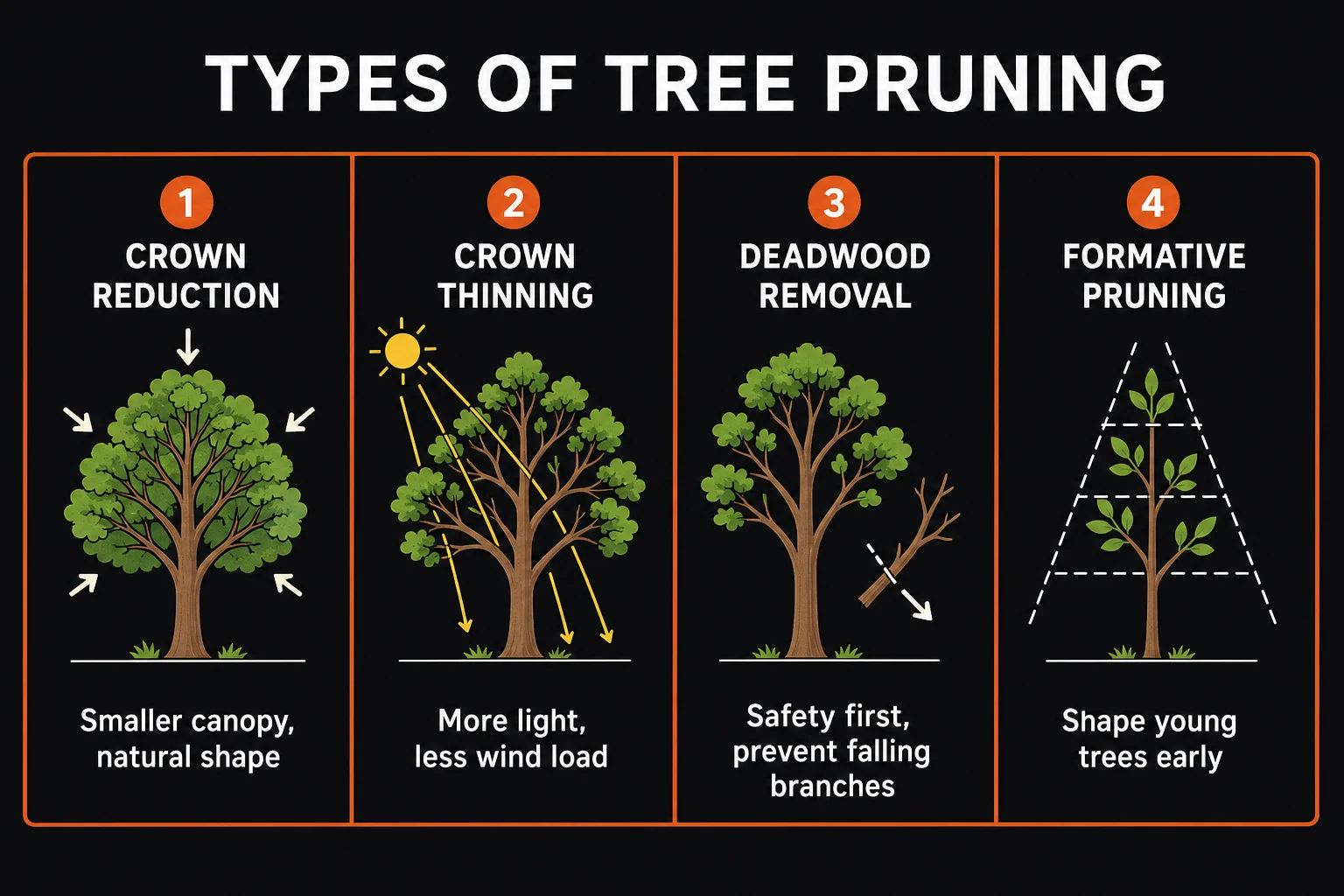
What tree pruning includes
- Crown reductions
- Reducing the overall size and spread of the canopy while keeping the tree's natural shape. Not lopping. Not topping. Controlled reduction.
- Crown thinning
- Removing selected smaller branches within the crown to reduce density while retaining the tree’s overall height and outline.
- Deadwood removal
- Dead, dying or weakly attached branches removed before they fall. Prevention, not reaction.
- Formative pruning
- Early shaping of young trees to establish good structure. Get it right early and you avoid expensive problems later.
What's not included
Pruning covers the tree work itself. Hedge trimming and stump grinding are separate services we also provide, priced separately unless listed in the written scope. See our hedge care and stump grinding pages. Protected-tree removal without consent is outside pruning. Where a survey is needed first, we also provide arboricultural surveys.

How we prune a tree
- Assessment. We look at the tree, its species, its condition, and what you want to achieve. More light? Less risk? Better shape?
- Quote. Written price before we touch anything. No hidden costs.
- The work. Cuts made to BS3998 recommendations at a time suited to the species and the tree’s condition.
- Clear up. Branches, timber and chip handled as stated in the written quote, and the working area left to the agreed finish.
Tree pruning services
We prune trees across County Durham and North Yorkshire, including Durham, Chester-le-Street, Consett, Bishop Auckland and Darlington. Larger specimens, high canopies or multiple trees are quoted individually, and you get the price before we start.
Qualifications and cover. NPTC qualified. LANTRA qualified. £10M public liability insurance. BS3998 standard on every cut. Written quote before any work begins.
What customers ask
Common questions
How much does tree pruning cost?
Larger trees, high canopies or multiple specimens cost more. We quote in writing before we start.
When is the right time to prune trees?
Most deciduous trees are best pruned in winter when dormant. Cherry, plum and stone fruit trees need summer pruning to avoid disease. We schedule work at the right time for each species.
What is the difference between crown reduction and topping?
Crown reduction controls size by cutting back to lateral branches. The tree keeps its natural shape. Topping is cutting straight across main stems, which damages the tree. We never top trees.
Can you prune trees near power lines?
It requires inspection. We assess the tree and its distance from the lines, then confirm whether coordination with the network operator is needed.
Need a tree pruned?
Send photos of the tree, its surroundings and access. We’ll arrange a site visit and written quote.