
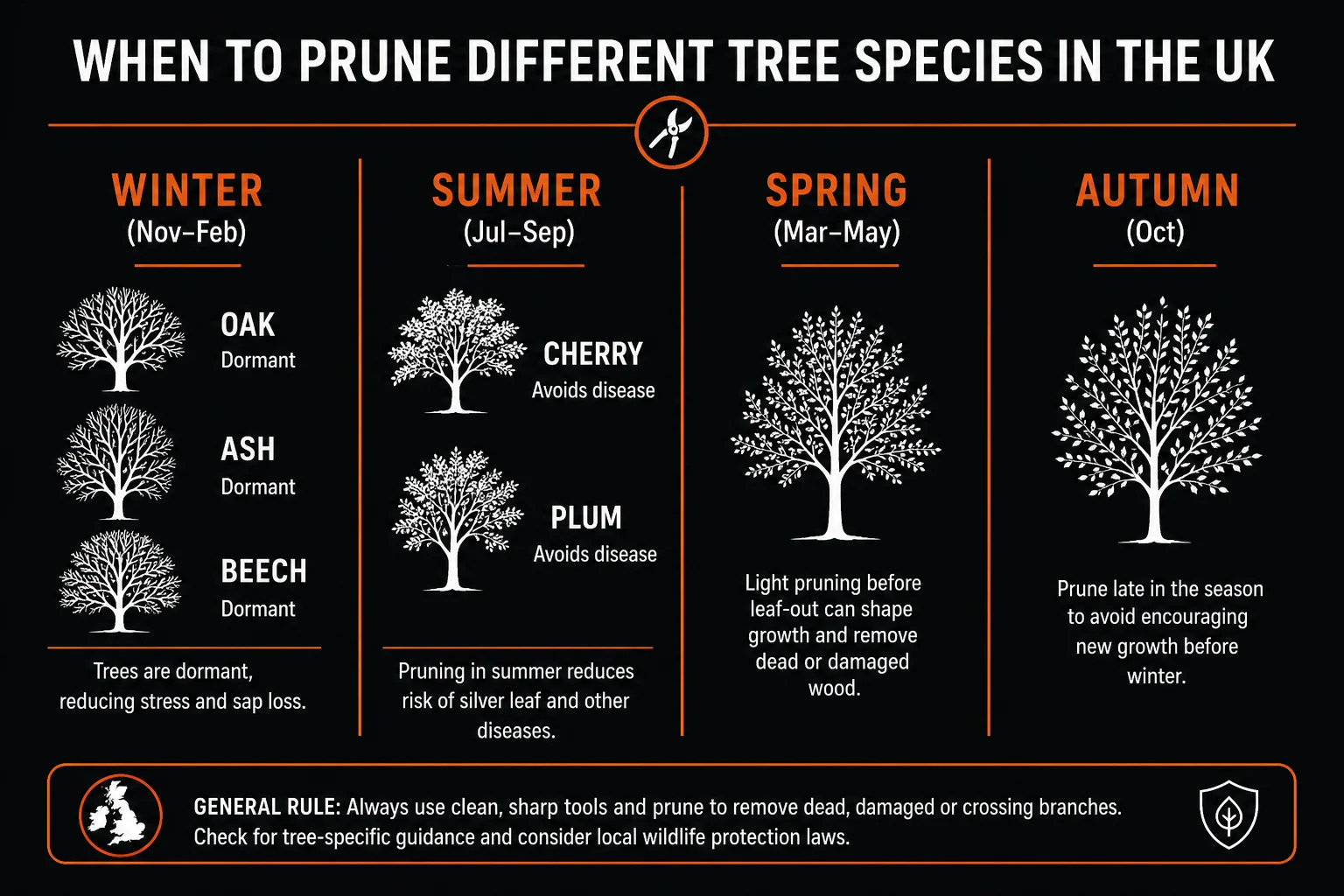
There is no single right month to prune a tree. Timing depends on the species, the condition of the tree, the work you want done and what the tree is growing near. Most deciduous trees are pruned in winter while they are dormant, cherry and plum are commonly scheduled for summer because of silver leaf risk, and some species are better left until late summer. This guide sets out the seasons we work to in the North East of England, and the reasons behind them.
Search for when to prune a tree and the advice disagrees. Some sources say late summer, others late spring through summer, and most working tree surgeons say winter. They are all right, for different species and different jobs, which is why the tree in front of you and the work you want done come first.
Use the species guide below as a starting point. For work in North Yorkshire or County Durham, send photos and your postcode so we can assess the tree and recommend suitable timing.
Why pruning timing matters
Timing affects disease risk and recovery, but it does not give a universal rule for every tree. Silver leaf is a fungal disease that infects pruning wounds, especially on susceptible trees such as plum and cherry. RHS guidance says infectious spores are active from September to May, so routine pruning of susceptible trees is planned for summer. Silvery leaves can also have non-disease causes, so symptoms alone do not confirm silver leaf.
A cut made in the dormant season has until spring to seal over, before the tree puts its energy into new growth. That is less time exposed to disease than a wound opened in the middle of the growing season. Timing is only part of it though: the size and position of the cuts, how much is removed and the condition of the tree all affect how well it recovers. The right month does not make a heavy or unsuitable reduction harmless.
The legal point is the nest, not a fixed nesting season. The Wildlife and Countryside Act 1981 protects wild birds, their nests and eggs in England. Before cutting, check the tree and stop if an active nest is present. Some birds have extra protection. See the GOV.UK guidance on wild birds.
The pruning calendar: what to prune when
Winter (November to February): the main season
Many deciduous trees are pruned while dormant, when bare branches make their structure easier to assess. That covers oak, ash, beech, lime, sycamore, hornbeam, willow and poplar, along with most garden ornamentals.
Apples and pears are the fruit trees we prune most often, and they follow the same window: November to early March, while the tree is leafless. The aim is an open-centred crown with well-spaced branches, so light reaches every part of the tree and air moves through it. That means better fruit and fewer pests and diseases. Take no more than about a fifth of the canopy in one winter. Cut harder and the tree answers with watershoots, the whippy upright shoots that crowd the crown and fruit poorly.
Late summer (July to September): the exception window
Cherry and plum are susceptible to silver leaf, a fungal disease that enters through wounds. The RHS recommends summer pruning of susceptible trees, when fewer infectious spores are present. It reduces risk rather than eliminating it.
Walnuts and magnolias are often pruned in summer because cuts made in winter or spring can bleed. Bleeding is usually unsightly rather than harmful, but prolonged loss of vigour is possible. A late-summer prune minimises bleeding and gives the wound time to seal before winter.
When to prune by tree species
| Tree type | Best time | Why |
|---|---|---|
| Oak, ash, beech, lime | Nov–Feb (dormant) | Clear structure, spring healing |
| Apple, pear | Nov–Feb (dormant) | Shapes tree, improves fruit |
| Cherry, plum | Jul–Sep (summer) | Reduces silver leaf risk |
| Magnolia, walnut | Jul–Sep (summer) | Minimises sap bleeding |
| Birch, maple | Late autumn | After leaf fall, before deep winter |
| Conifer hedges (Leylandii) | Growing season, subject to nest checks | Usually two or three cuts a year to hold a clean line |
| Evergreen shrubs | Apr–Sep | Growing season recovery |
| Dead or damaged branches | Assess urgency first | Permissions and wildlife protection still apply |
What happens if you prune at the wrong time

Silver leaf disease. This fungal disease can infect pruning wounds on susceptible trees such as plum and cherry. It can cause silvering, branch dieback and staining, but silvering can also have non-disease causes. Suspect symptoms need an assessment rather than an automatic diagnosis.
Excessive sap bleeding. Birch, walnut and maple bleed heavily if cut in spring. Bleeding can look alarming but is usually not harmful. Prolonged heavy bleeding is uncommon, though a stressed tree can lose vigour, so avoid spring pruning of these species where practical.
Weak regrowth. Heavy or unsuitable pruning produces epicormic growth: vigorous shoots from the trunk and main limbs that need later management and, on fruit trees, fruit poorly. The extent and position of the cuts matters, not just the season.
Dieback. If the tree was already stressed, a badly timed prune can tip it over. Branches die back from the cut. Recovery takes years, if it happens at all.
If a tree has already been pruned heavily or shows dieback, ask for an assessment before making more cuts. Further pruning is not always the right next step.

What pruning costs and why timing affects price
Timing affects availability. Winter is the busiest season for tree work in the North East, because that is when most deciduous trees are pruned. Book a winter prune in the autumn and you get a better choice of dates than calling in January.
Tree pruning is quoted per job. The tree’s size, the cuts required, access, lowering equipment and waste removal affect the price. Season alone does not make two jobs comparable. For the work included in a quote, see our tree pruning service.
Common questions
- When is the best time to prune trees in England?
- For many deciduous trees, winter is a common schedule when dormant. Cherry and plum are often planned for summer because RHS guidance identifies autumn to spring as the main silver-leaf spore period. Summer lowers the risk, but does not guarantee disease will not occur. Consider species, condition, purpose and any active nest.
- What happens if I prune a tree at the wrong time of year?
- It depends on the species and the work. Cherry and plum pruned in winter have a higher silver-leaf risk. Birch and walnut may bleed when cut in spring, although bleeding is usually not harmful. Other trees may recover more slowly or produce weak regrowth, depending on their condition and the extent of the cuts.
- How often should trees be pruned?
- Most garden trees need attention every two to five years depending on species and growth rate. Some fruit trees need annual pruning, but the season depends on the species and the type of fruiting wood. Fast-growing trees like willow and poplar may need work every two to three years.
- Do I need permission to prune a tree?
- You may need permission if the tree is in a conservation area or has a Tree Preservation Order. Check with your local council. For a dead tree, removal normally requires five working days’ written notice to the council, subject to the statutory conditions. Immediate work to remove a serious risk is limited to what is necessary, with notice as soon as practicable afterwards. A TPO or conservation-area restriction is not a general permission to proceed.
- How much does tree pruning cost in County Durham?
- We quote per job after a site assessment rather than publish a rate, because the same tree prices differently on two sites. Size and form, access, what sits under the tree, the method and what happens to the arisings all move the figure. See tree pruning for what drives the price, or send photos and a postcode for an assessment.
- What is the difference between crown reduction and topping?
- Crown reduction controls a tree's size by cutting back to lateral branches. The tree keeps its natural shape. Topping is cutting straight across the main stems, which damages the tree and encourages weak regrowth. We never top trees.
Got a tree that needs work?
We review the situation. We give you a fixed quote. No hidden costs. What we quote, you pay.