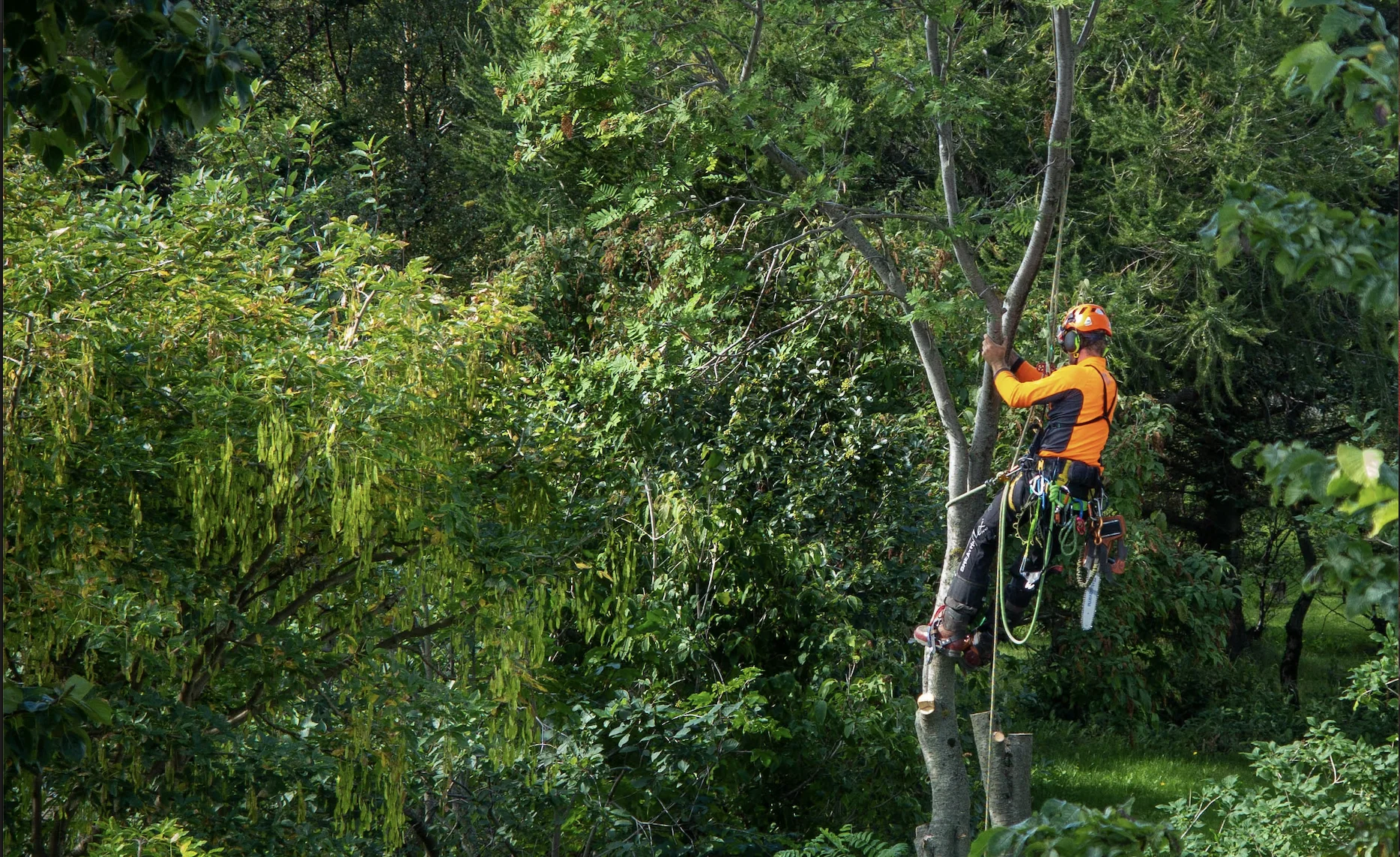
What a Tree Preservation Order actually restricts
A Tree Preservation Order, or TPO, is made by the local planning authority in England. It can cover one tree, a group, a defined area or a whole woodland. Once it is in place, cutting down, topping, lopping, uprooting or wilfully damaging that tree without the council's written consent is a criminal offence.
A TPO is a consent system, not a ban. Proportionate pruning, argued properly, is usually granted. Felling a healthy, prominent tree for convenience usually isn’t. The route matters.
The work that needs written consent
Consent covers more than felling. Any pruning counts: a crown reduction, a crown lift over a drive, a thinning, or cutting back branches that overhang a boundary. Root damage counts too, so a drainage trench inside the rooting area is work on the tree even though nobody touches the canopy. If a hedge has protected trees in it, cutting back to those stems needs consent as well.
What a TPO doesn’t change
It doesn’t make the council responsible for the tree. You still own it, you still owe a duty of care to anyone it could hurt, and you still pay for the work.
How to find out whether a tree is protected before you commit
Do this before you accept a quote, not after the saw is running.
- The council's TPO register or map
- Most authorities publish a searchable map, or will confirm an address by email. Ask for the order reference and its schedule, not just a yes or no. The schedule says which trees are listed, and old orders often describe trees that are no longer standing.
- Conservation area status
- A separate check, and the one most often skipped. A tree with no TPO on it can still be protected because of where it stands.
- Planning conditions and survey documents
- On anything built in the last thirty years the trees may be tied to a landscape condition or a retained-tree plan. See BS5837 tree categories and tree surveys.
Get the answer in writing and keep it.
Conservation areas and the section 211 notice
In a conservation area, trees are not automatically protected in the TPO sense, but a section 211 notice is needed before cutting down, topping, lopping or uprooting a tree whose trunk is more than 75mm across, measured over the bark at 1.5 metres from the ground. A multi-stemmed tree is caught if any single stem exceeds that measurement. You serve the council a section 211 notice instead of a consent application: written notice of what you intend to do, to which trees.
What the six-week period is for
The council then has six weeks, and the tree is left alone while that runs. Three things can happen. It may make a Tree Preservation Order, which stops the work and moves you onto the consent route. It may decide not to make an order and tell you the work can go ahead. Or it may decide not to make an order and simply let the six weeks run out, after which the work described in the notice can be carried out within two years of the notice date. Only the work described is covered; anything beyond it needs its own notice or application. A section 211 notice is not an application for consent, so the council cannot refuse it or attach conditions to it.
When the council answers with a TPO
This happens, usually where a notice proposes felling a tree that reads as part of the street scene. An order takes effect the day it’s made. It is still no reason to skip the notice: working without one is the offence, and an order only moves you onto the consent route.
What happens if you cut a protected tree without consent
It is a criminal offence and it is prosecuted. For cutting down, uprooting or destroying a protected tree the fine is up to £20,000 in the magistrates’ court, and unlimited if the case goes to the Crown Court. The court must take account of any financial benefit from the work, so "it was in the way of the plot" is an aggravating point rather than mitigation. Pruning beyond what was granted carries a lower maximum fine, currently up to £2,500.
Who is liable
The owner who instructed the work and the contractor who carried it out can both be prosecuted, and not knowing the tree was protected is no defence. A contractor who never raises TPOs before quoting for pruning or tree removal is a risk to you.
The replacement tree
Separately from any fine, the council can require a replacement of appropriate size and species in the same place. That duty attaches to the land, so it can follow the property to the next owner, and the new tree goes back where you wanted the space.
The exemptions that genuinely exist, and how narrow they’re
There are real exemptions. They’re narrower than most people hope, and if one is challenged you’re the one proving it after the event.
Dead trees and dead branches
The exemption for dead trees is narrower than the short version of it sounds. You do not need consent for work on a tree that is genuinely dead, and dead branches can be taken out of a living one, but the condition still has to be met before the saw comes out. In England you give the council five working days' written notice before removing a dead protected tree, and where a tree is an immediate danger the notice goes in as soon as practicable afterwards. The exemption covers only the work the condition actually requires, nothing else on the tree, and a duty to replant can still apply. Dead means dead. Not dying, not in decline, not half the crown gone. Photograph the tree first.
Trees that are an immediate danger
Urgent work to remove an immediate risk of serious harm is exempt, but only the minimum work that removes the risk. A storm-damaged limb over a footpath is exempt; the rest of the tree isn’t. Notice goes to the council as soon as practicable afterwards. If there’s any time at all, ring the tree officer first. See emergency tree work.
A statutory obligation
Where another statute requires the work, a TPO doesn’t override it. It arises on highway and utility sites, not in gardens. If someone says a garden tree can come out under a statutory obligation, ask which statute.
What isn’t an exemption: a tree blocking light, dropping leaves, lifting a patio, or holding back the value of a plot. Subsidence claims go through a consent application with engineering evidence, not through an exemption.
Applying for consent, and how long it really takes
Who applies and what the application needs
The owner applies, or an agent with the owner's written authority, so a tenant needs the freeholder on side. There’s no application fee. What the council wants to see:
- A plan showing the trees
- A site plan or clear aerial image with each tree marked and numbered.
- The work described in arboricultural terms
- Not "cut it back". A crown reduction with the extent stated, a crown lift to a given height, a thinning proportion, or removal. See tree pruning.
- The reason, with evidence
- Photographs, plus an arborist's or engineer's report where you claim a defect or damage. One reason an officer can verify beats three they can’t.
- Any replanting you’re offering
- A replacement of a sensible species in a sensible position makes a felling application easier to support.
Realistic timescales
Councils work to eight weeks on a consent decision, and simple pruning applications often come back inside a month. Contested felling applications use the full period, and where an application is incomplete the council can declare it invalid rather than determine it, so send everything it asks for in one go. Consent normally has to be used within two years, so there’s room to work around nesting season and wet ground. A refusal can be appealed to the Planning Inspectorate within 28 days, and appeals run in months. Allow a season, not a fortnight.
Can conifers and hedges be protected?
Conifers carry a TPO like anything else
An order can cover any species, leylandii and Lawson cypress included. Species is irrelevant; amenity value is what the council assessed. A screen planted forty years ago can sit inside an area or group order without the owner knowing. That’s the most common protected-tree surprise we run into. Check before booking a conifer removal.
Hedges are regulated under a different Act
Hedge height sits outside the TPO system. It falls under the High Hedges provisions in Part 8 of the Anti-social Behaviour Act 2003, which apply in England and Wales. A remedial notice cannot require the hedge to be reduced below 2 metres, and cannot require its removal. That’s the ceiling on what a complaint can achieve. See leylandii height law and removal for that process, and domestic hedge cutting rules for timing and nesting birds.
Where both systems touch the same plants, the stricter one governs. If a remedial notice tells you to reduce a hedge and the trees in it are covered by a TPO, you still need consent before cutting.
How we handle protected trees
We check the status of the tree before quoting. If it’s protected, we write the scope in the terms the application needs, then work to what was granted. If the answer is no, we’ll say whether a reduced scope has a chance.
Send the address, photographs of the tree and its base, and the order reference if you have it. Request a protected-tree check and we’ll confirm which route the work needs.
Qualifications and cover. NPTC and LANTRA qualified. Constructionline Gold certified. £10M public liability insurance. Written scope and quote before any application goes in.