
Key points
- Quick summary of the hedge cutting rules
- The Wildlife and Countryside Act 1981
- Does the law apply to garden hedges?
- Can you cut a hedge at any time of year?
- The fine if you get it wrong
- What about the neighbour's hedge blocking your light?
- Hedge cutting seasons by species
- How we cut hedges in the North East
- What hedge cutting costs
Domestic hedge cutting in England has no fixed closed season, but active bird nests are protected all year. Check before every cut. This guide explains nesting rules, overhanging branches and how garden hedges differ from agricultural hedgerows.
Quick summary of the hedge cutting rules
- Nesting birds: the rule that covers every hedge
- The Wildlife and Countryside Act 1981 protects nests while they are in use or being built. Stop work that could harm an active nest, regardless of the month. Some bird species have additional protection against disturbance.
- There’s no closed season for a garden hedge
- The Act works on whether a nest is there, not on dates. A domestic garden hedge can lawfully be cut at any time of year provided there’s no active nest in it. September to February is the safest window because that’s when you’re least likely to find one.
- 1 March to 31 August is a farming rule
- Hedgerows on agricultural land have a separate closed period running from 1 March to 31 August, and it applies whether or not a nest is present. That’s an obligation on the land manager. It doesn’t apply to a hedge in a domestic garden.
- Taking a countryside hedgerow out is controlled separately
- The Hedgerow Regulations 1997, in England and Wales, control the removal of hedgerows in the countryside, mainly those on or adjoining agricultural land. They’re about removal, not trimming, and they don’t cover a hedge within the boundary of a house.
- Branches overhanging your side
- You may cut what overhangs your property, back to the boundary line and no further. You must not cut anything on your neighbour's side, and you must offer the cuttings back. Check for nests before you start.
- A hedge that’s too tall
- You can complain to the council under the High Hedges provisions in Part 8 of the Anti-social Behaviour Act 2003, in England and Wales. Know what that gets you: a remedial notice cannot require the hedge to be reduced below two metres, and it cannot require the hedge to be removed.
- If you get it wrong
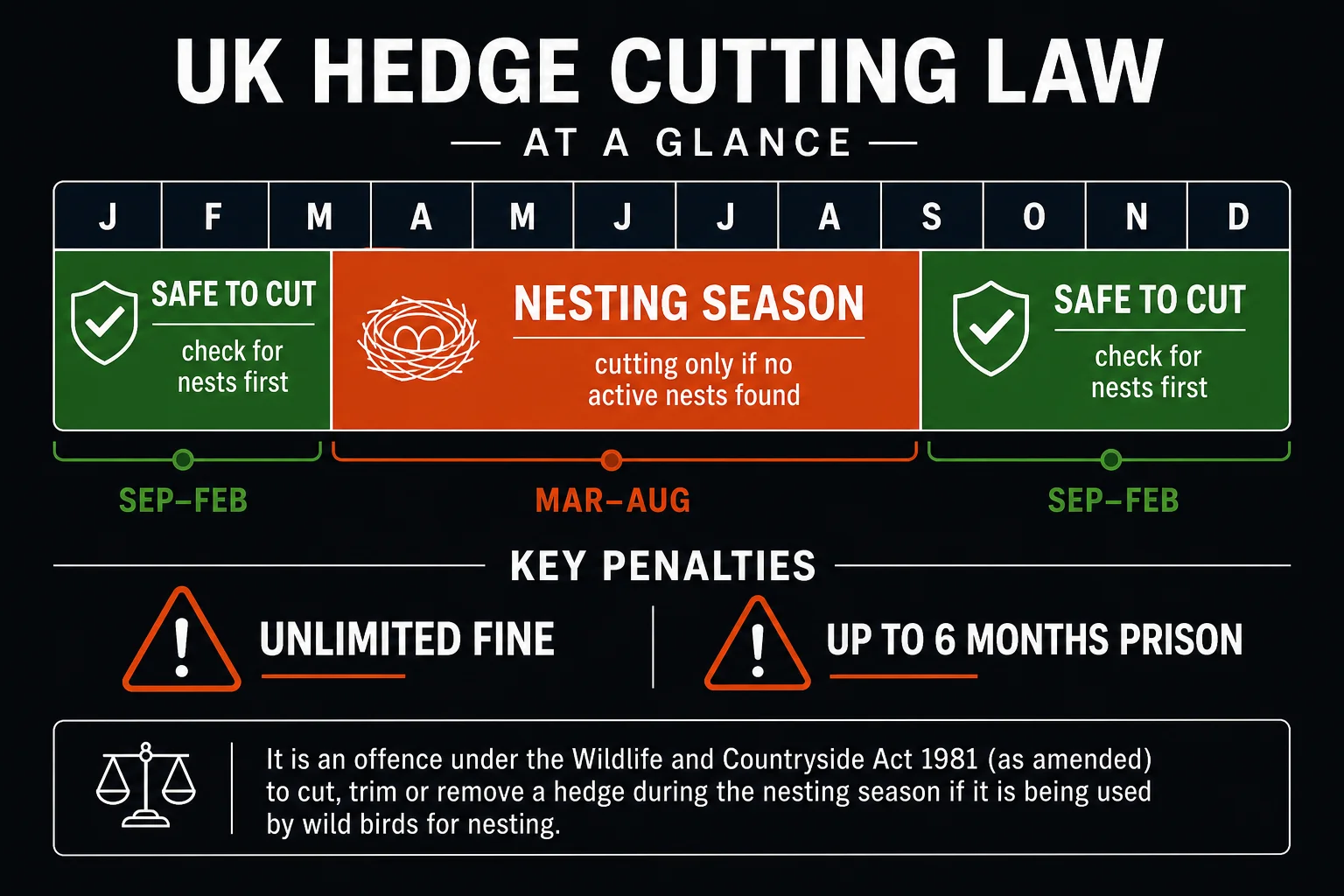
- Damaging or destroying an active nest is a criminal offence carrying an unlimited fine and up to six months in prison, plus a criminal record.
Send the hedge location, current height, target height, species if known and photos. See our hedge care service for routine maintenance. If the hedge cannot recover from reduction, hedge removal may be the better route.
The Wildlife and Countryside Act 1981
For England, the GOV.UK guidance on wild birds explains the protection of nests and eggs. There is no fixed closed season for a domestic garden hedge under that rule. Agricultural hedgerow management has separate requirements, so the land use matters. See the official wild bird guidance.
The nesting season is generally March to August. But birds don’t follow a calendar. I have seen wood pigeons nesting in February during a mild winter. Some species nest into September. The law doesn’t give fixed dates. It says: if there’s a nest, you leave it alone.
So the practical rule is simple: check the hedge before every cut. Even in December. Cutting without checking risks harming protected birds or damaging an active nest. We check every hedge we’re asked to trim. If we find a nest, we mark that section and come back after the birds have gone. There’s no exception for convenience.
Does the law apply to garden hedges?
Yes. The nesting bird protection covers every hedge. A privet hedge in a back garden has exactly the same standing in law as a hawthorn field boundary, and the same check has to be done before either one is cut. What differs is everything else. The rules written for farmland hedgerows don’t reach into a domestic garden, and that’s where most of the confusion on this subject comes from, so it gets its own section next.
Can you cut a hedge at any time of year?
If it’s a garden hedge, yes. There’s no closed season for domestic hedge cutting. You can cut in May if you need to, provided there’s no active nest in the hedge. The only date that matters is the day you look at it.
The Wildlife and Countryside Act 1981 works on the presence of a nest, not on the calendar, and it is in force every day of the year. A nest in February is protected in exactly the same way as a nest in June. So the question to ask isn’t "is it nesting season", it’s "is there a nest in this hedge today".
Where the 1 March to 31 August dates actually come from
Those dates get quoted at homeowners constantly, and they’re being quoted out of the wrong rulebook. The 1 March to 31 August closed period applies to hedgerows on agricultural land. It is an obligation on the land manager, it is enforced against farms, and within that window it bites whether or not there’s a nest in the hedge.
A hedge in a domestic garden isn’t on agricultural land and isn’t covered by it. Nor is it covered by the Hedgerow Regulations 1997, which control the removal of countryside hedgerows and don’t extend to a hedge within the boundary of a house. If your hedge separates your garden from next door's, neither of those rules is about you.
What that means in practice: nobody can tell you that cutting your own garden hedge in June is illegal, because it isn’t. What they can tell you, and they would be right, is that June is the month you’re most likely to find a nest in it, and that cutting through an active nest is a criminal offence.
The window we work to, and what we do outside it
September to February generally carries less nesting risk, but it is not a guaranteed safe window. Check before cutting and choose a time suited to the hedge species.
Outside that window we still cut, and we still check first. We walk the length of the hedge, looking and listening. If there’s an active nest, we stop affected work and assess whether any work elsewhere can proceed without harming birds or the nest. We return to the affected section once it is no longer in use. Birds don’t follow the calendar either way, which is why the check matters more than the date does.
The fine if you get it wrong
Damaging or destroying an active nest, or its eggs, is a criminal offence. Stop work on that section and follow the GOV.UK wild bird guidance. A neighbour’s report can bring the issue to the authorities, so check before cutting and keep a record of what you found.

What about the neighbour's hedge blocking your light?
This is one of the questions I get asked most. Your neighbour's hedge is growing over the boundary, blocking your light, encroaching on your garden. What can you do?
You can cut any branches that overhang your property, right up to the boundary line. You must not cut anything on their side. You must offer the cuttings back to the neighbour. They can say no, but you have to ask. Throwing them back over the fence is fly-tipping. And before you cut, check for nests. The same law applies.
If the hedge is so tall it blocks light to your windows, you may be able to complain to the local council under the High Hedges provisions in Part 8 of the Anti-social Behaviour Act 2003. These apply in England and Wales, and only to a line of two or more mostly evergreen or semi-evergreen trees or shrubs acting as a barrier to light or access.
What the council can and can’t order
This is the part people usually get wrong. If the council upholds the complaint, it issues a remedial notice telling the owner what to do about the hedge. That notice cannot require the hedge to be reduced below two metres, and it cannot require the hedge to be removed. So a complaint is a route to getting a very tall hedge brought down to a manageable height. It isn’t a route to having it taken out.
The council sets its own process and fee, and the complaint can take time. The council will also expect to see that you’ve tried to settle it with your neighbour first. Talk to them before you spend anything. In practice a tree surgeon can often reduce the hedge from your side, or agree a reduction with both parties, faster and for less than the complaint fee.
Hedge cutting seasons by species
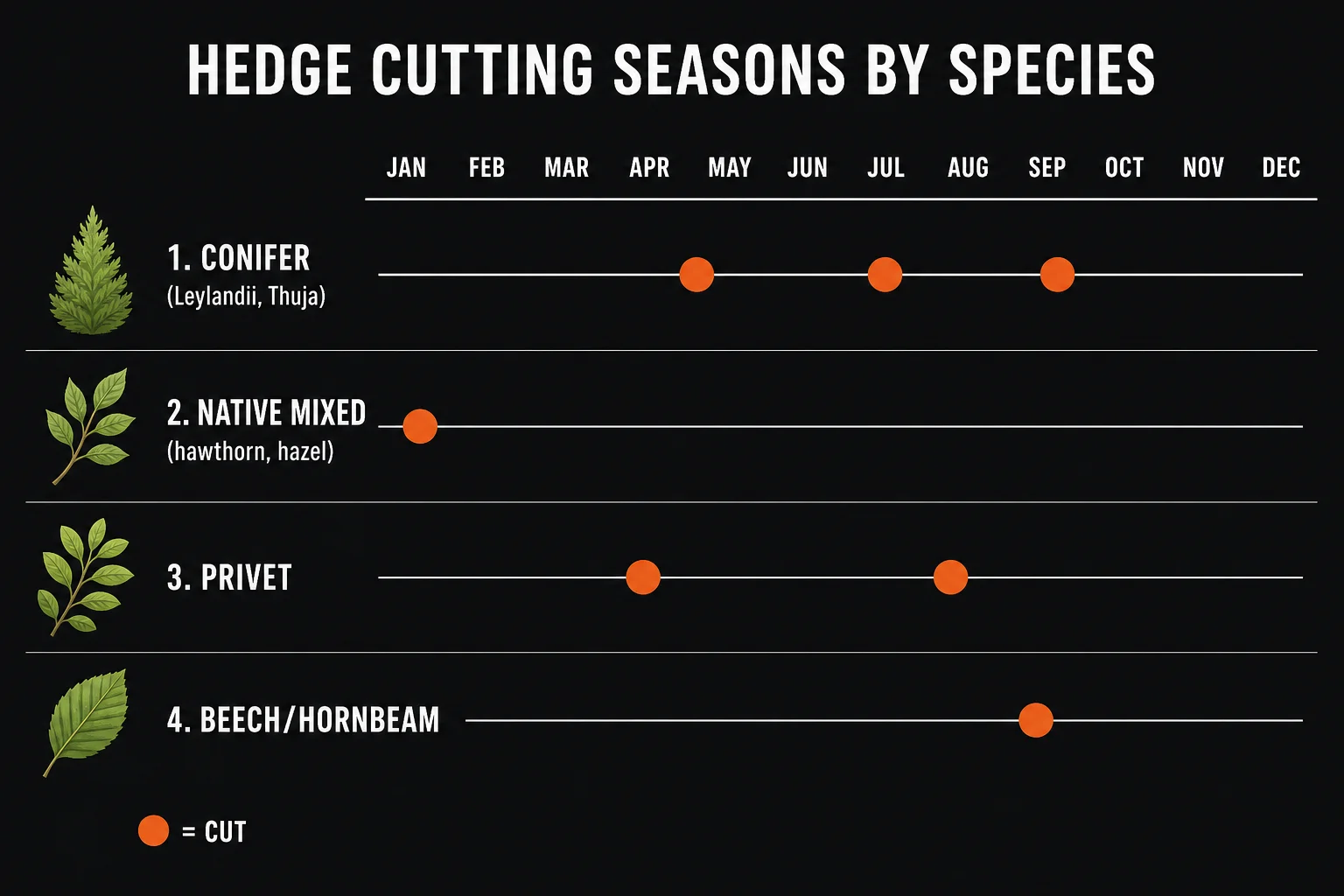
Conifer hedges (Leylandii, Thuja etc.). Two to three cuts per year. First cut in late May after the last frost. Second in late summer. Never cut conifers back to bare wood. They don’t regrow. The brown patches stay forever.
Mixed native hedges (hawthorn, blackthorn, hazel). One cut per year in late winter, January or February. This keeps the hedge dense and healthy without disturbing nesting birds or removing flowers and berries.
Privet. Two cuts per year. Late spring and late summer. Privet grows fast and goes leggy if left alone. Regular trimming keeps it dense.
Beech and hornbeam. One cut per year in late summer, August. Beech holds its dead leaves through winter if trimmed then, giving you year-round privacy.
Box. One cut in June or July on a dry day. Box blight is a risk. Clear all clippings.
How we cut hedges in the North East
Every hedge cut starts with a nest check. We walk the length of the hedge, looking and listening. If we find a nest, we mark it, leave that section, and come back after the birds have left. This isn’t optional. It’s the law, and it’s the right thing to do.
In County Durham, spring comes later than the south. We don’t cut conifers before the last frost because the new growth will burn. Native hedges get their winter cut in February, just before the sap rises.
What hedge cutting costs
Hedge cutting is quoted per job. Length, height, density, access and the amount of waste affect the price. A light trim and a substantial reduction are different jobs, even on the same hedge. Send photos, approximate dimensions and your postcode for a written quote.
Common questions
- Can I cut my hedge any time of year?
- Yes, provided no birds are nesting in it. The law doesn’t set fixed dates for garden hedges. Check first, cut second. The safest window is September to February when most birds aren’t nesting.
- What happens if I cut a hedge with birds nesting in it?
- Damaging or destroying an active nest or its eggs is a criminal offence. Stop work on that section and refer to the GOV.UK guidance on wild birds. Do not assume a contractor, neighbour or organisation will overlook it.
- Can I cut my neighbour's hedge overhanging my property?
- You can cut branches that overhang your boundary, up to the property line. You must offer the cuttings back. You can’t cut anything on their side. Check for nests first.
- What are the rules on cutting hedges in England?
- In England, it is an offence to intentionally damage or destroy a wild bird’s nest while it is in use or being built. Some birds also have extra protection from disturbance. Agricultural cutting restrictions and countryside hedgerow removal rules are separate from domestic garden hedge cutting.
- How much does hedge cutting cost in County Durham?
- We quote per job after a site assessment. Length, height, density, access and what happens to the arisings all move the figure, and large or neglected hedges take longer and produce more waste. See hedge care for what drives the price, or send photos and a postcode for an assessment.
Got a tree that needs work?
We review the situation. We give you a fixed quote. No hidden costs. What we quote, you pay.