
Tree Removal in North Yorkshire & County Durham
Tree removal across North Yorkshire and County Durham, including large trees and work near buildings. Site assessment, agreed clearance and a written quote.
Free site visit. Written quote. No obligation.
- NPTC qualified
- LANTRA qualified
- £10M public liability insurance
- BS3998 standard
Completed work
Before and after: ash tree overhanging an outbuilding
This ash tree overhung an outbuilding, so it was sectionally dismantled rather than felled in one piece. Sections were removed under control around the building.
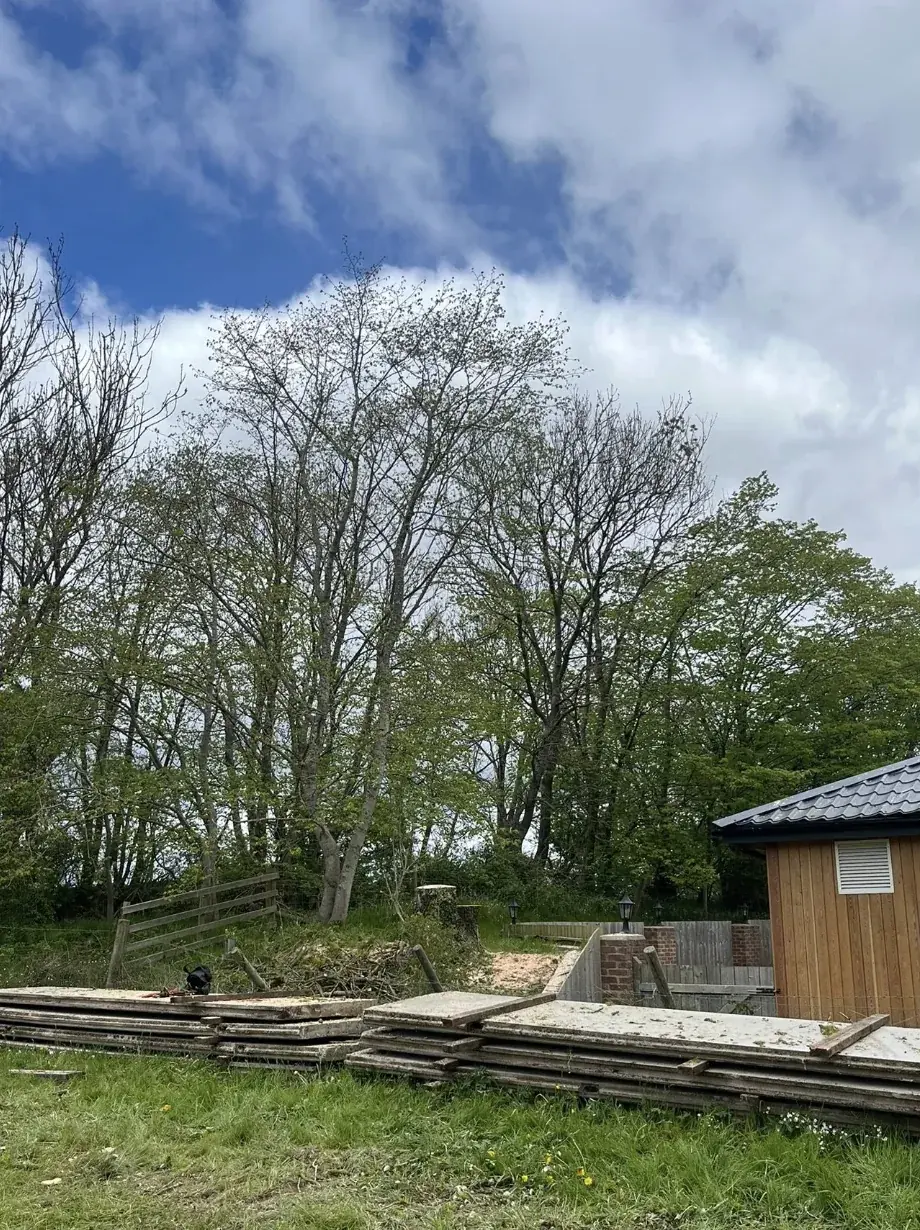
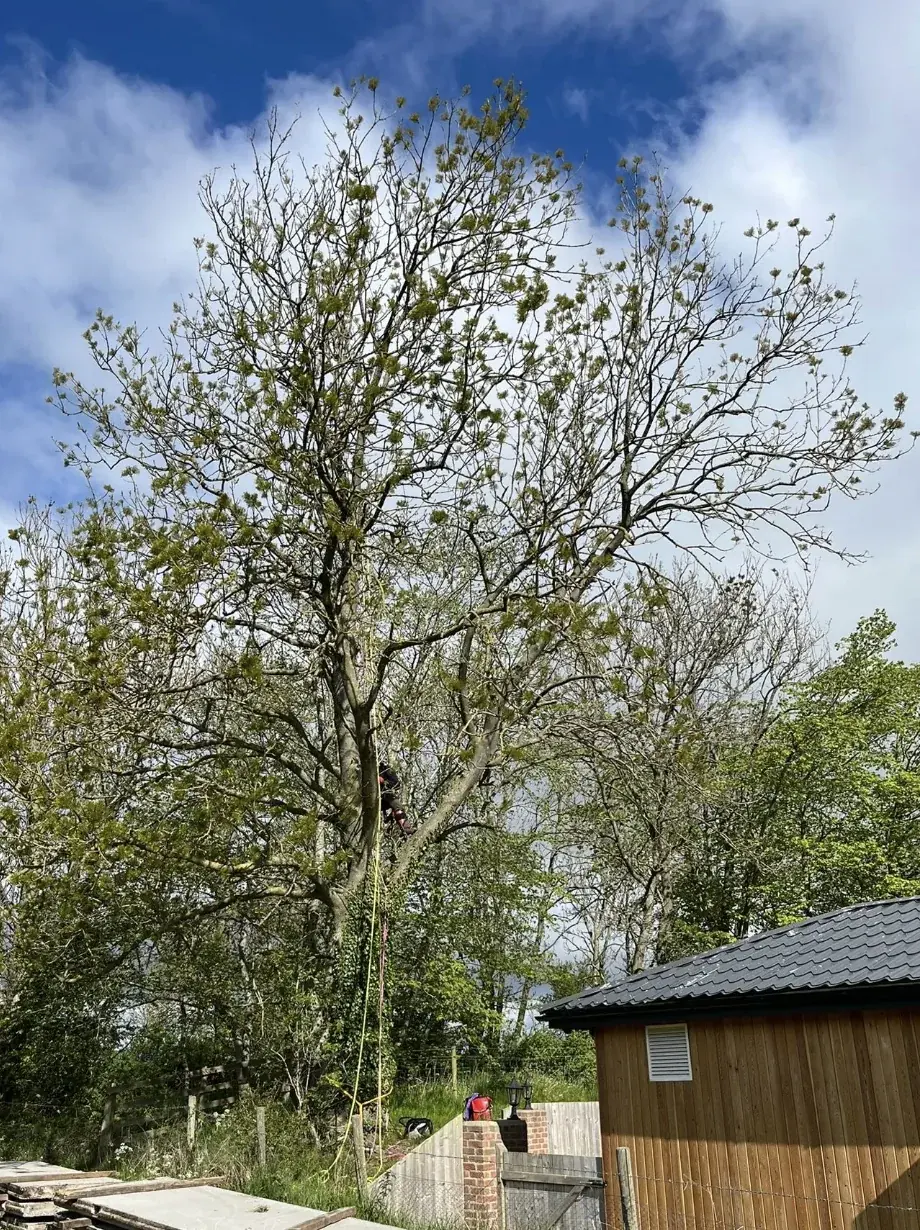 BeforeAfter
Tree removal services
Need a tree removed from your garden or land? We fell trees where there is room, or take them down in sections around buildings, fences and other obstacles. The two methods are straight felling, where the tree goes over in one piece, and sectional dismantling, where it is taken apart from the top and lowered under control. Tree felling and sectional dismantling explains how the method is chosen.
We check the tree, access and any permissions before giving you a written quote. It sets out the removal work, timber clearance and whether stump grinding is included.
If you’re not sure the tree needs to come down, we’ll assess it and explain the options.
Choose the right starting point: planned removal after an assessment confirms that taking the tree out is the suitable option; emergency tree work for a standing or fallen hazard; or stump grinding when the tree is already down and the stump is the problem.
How we assess a tree before removal
You can send photos or a short video by email or WhatsApp for an initial evaluation before we visit. If it’s safe to do so, include the whole tree, the base, nearby buildings and the access route. Photos help us understand the job before we arrive. They don’t replace the site visit.
At the visit, we assess the tree’s condition, the space around it and access for equipment and timber clearance. We confirm how the job can be done and what it will cost.
Hanging branches, new cracks, a worsening lean, fungal growth or storm damage are reasons to have a tree checked. They do not automatically mean removal is needed. Depending on its condition and surroundings, pruning or monitoring may be enough.
How a tree is removed
The method depends on the tree’s condition, access and the space around it. Where there is a suitable clear area, it may be felled in one piece. Around buildings and boundaries we usually take it down in sections: tree dismantling rather than felling.
- Straight felling
- Used where there’s enough open ground for the tree to fall safely. A directional cut is made at the base, the tree is guided into the drop zone, and the stem is cut into rings on the ground. Fastest method, lowest cost, needs open space.
- Sectional dismantling
- Used where a tree cannot be felled in one piece. Branches and stem sections are removed in stages and lowered on ropes where needed. It takes more time and equipment than straight felling. Work near overhead lines needs controls agreed with the network operator.
- Mechanical dismantling
- Where climbing is not suitable, we assess whether a mobile elevating work platform or crane can be used. The equipment, access arrangements and additional cost are agreed before the work starts.
We decide the method after the site visit. You don’t need to know which one applies when you contact us. That’s our job.
Large and mature tree removal
Size changes the assessment rather than the principle. A large or mature tree carries heavier sections, more timber and further to move it, so the working room, the ground under it and the route out all matter more than they do on a small garden tree.
- Condition and structure. Included bark, cavities, dead limbs and historic pruning wounds all affect how and where the tree can be taken apart. Where climbing is not suitable, we assess a mobile elevating work platform or a crane.
- Weight and control. Heavy sections have to be lowered rather than dropped. That means rigging points, rope work and a clear landing area agreed before cutting starts.
- Ground and access. Equipment and ground protection are chosen for the site in front of us. A firm lawn with a wide gate may need nothing; soft ground, a slope or a narrow side return may need matting or a smaller machine.
- Material handling. Large trees produce a lot of timber and brash. Tell us whether you want logs left, woodchip left, or everything taken away, because it changes the crew, the vehicle and the time on site.
Tree removal near a house or boundary
Most removals in built-up areas are not really about the tree. They are about the building, the fence, the greenhouse and the neighbour's extension two metres away.
Where there is no room to fell, the tree is dismantled in sections and every piece is controlled on a rope or lowered into an agreed drop zone. We look at which way the tree leans, where its weight sits, what is underneath it and how far a section would travel if it moved unexpectedly. Fences, drains, patios and boundary walls are identified before work starts so they can be protected or avoided.
If the tree sits on a boundary, we agree the working area and access with you before the day. Where a neighbour's land is needed for access or for lowering material, that is arranged in advance rather than discovered on the morning.
How tree removal works
- Send the details. Email or WhatsApp photos, video, the location and a short description of what you need.
- Site visit. We inspect the tree, access, available working space and nearby property.
- Written quote. The quote confirms the removal method, clearance, stump work and price.
- Tree removal. We arrive with the right team and equipment, remove the tree using the agreed method and clear the site.
After the tree is down
We can quote for stump grinding alongside the removal, or leave the stump if you prefer. Tell us how you want to use the space so we can agree the finish before work starts.
The timber and branches are cleared from site as standard. We can leave logs cut to a specified length if you want firewood, and woodchip can be left for mulching. Material removed from site is normally processed for firewood, mulch or biomass.
Tree preservation orders and conservation areas
We check whether a Tree Preservation Order (TPO) or conservation-area rules affect the proposed work. Protected trees normally need council consent or notice before removal, subject to limited exceptions. We explain what is needed and agree who will handle any application before booking the work.
Different rules apply to dead trees and trees presenting an immediate risk of serious harm. Dead protected trees normally require five working days' written notice. Urgent work to a dangerous tree must be limited to what is needed to remove the immediate risk, with notice given to the council as soon as practicable. Diseased or dying trees may still require consent. We document the condition and confirm the correct route with the council before work starts wherever circumstances allow.
Local removal work follows the same rules across our patch. Where a conservation area covers a village core, the local consent route and access notes sit on the page for that area: see tree removal around Sedgefield, Thirsk and Yarm. The full coverage list is on areas we cover.
Removal around Bishop Auckland, including Ash dieback work, is covered on the tree surgeon Bishop Auckland page.
Urgent tree work
If a tree has fallen or looks unsafe, contact us straight away. Send photos or video if it’s safe to do so. We assess the situation and respond based on the site, weather, safe access and current call-outs. We prioritise each call based on the immediate risk. Keep clear of the tree and call rather than approaching it to take photos.
A standing tree that looks unsafe belongs with emergency tree work, not a routine removal booking. A tree already on the ground is covered by fallen tree removal.
If the tree has already come down, see our fallen tree removal page for what happens next.
Tree removal prices
Tree removal is quoted per job, not by a fixed rate, so the cost to remove a tree depends on the job in front of us. Our tree removal cost guide explains what drives the price in the North East. On any job, the price depends on:
- The tree itself
- Species, height, spread, condition. A 40-foot beech with a clean stem is a different job from a 60-foot sycamore with multiple stems and a decay pocket in the main fork.
- Access and the working area
- Can we get equipment to the tree without lifting fences or crossing delicate ground? Is there space to lower sections or does every piece need to be carried out by hand?
- The drop zone
- What is under and around the tree. A tree in an open field is straightforward. A tree overhanging a conservatory, a neighbouring fence and a greenhouse isn’t.
- What happens to the timber
- Processing large stems into firewood takes time. If you want logs left on site, we quote accordingly. If everything goes, we factor in the disposal run.
- The stump
- Stump grinding is a service we also provide, separate from the removal. The quote states whether it’s included or priced separately. See our stump grinding page.
The written quote sets out the full cost before work starts.
What's not included
Landscaping and ground repairs are not part of tree removal. We confirm any additional work separately. If a tree survey is needed before removal, we explain that before you book.
Qualifications and cover. NPTC qualified. LANTRA qualified. £10M public liability insurance. Site-specific risk assessments and method statements before we arrive.
What customers ask
Common questions
What affects the cost of tree removal?
The tree itself (species, height, spread, condition). Access to the site and the working area around the tree. What is under and around the tree (the drop zone). What happens to the timber (taken away or left as logs). Whether stump grinding is included. We confirm the price in writing after the site visit.
Do you carry out emergency tree removal?
Yes. If a tree has fallen or looks unsafe, contact us straight away. Send photos or video if it’s safe to do so. We assess and respond based on the site, weather, safe access and current call-outs.
What is sectional dismantling?
Removing a tree in stages where it cannot be felled in one piece. Branches and stem sections are lowered on ropes where needed to protect nearby property. We assess whether climbing or mechanical access is suitable for the tree.
Can you tell me if my tree doesn’t need removing?
Yes. Some trees look worse than they are. We assess the tree honestly. If pruning or monitoring is enough, we’ll tell you. We don’t recommend removal unless it is genuinely needed.
Do I need permission to remove a tree?
A tree may be protected by a Tree Preservation Order (TPO) or stand in a conservation area. Dead trees and trees presenting an immediate risk are subject to limited exemptions with separate notice and evidence requirements. Diseased or dying trees may still require consent. We check what applies and deal with the council where required.
What happens to the timber after removal?
Timber and branches are cleared from site as standard. We can leave logs cut to length for firewood and woodchip for mulch. Material removed from site is normally processed for firewood, mulch or biomass.
Ready to sort that tree?
Free site visit. Written quote. No obligation.