
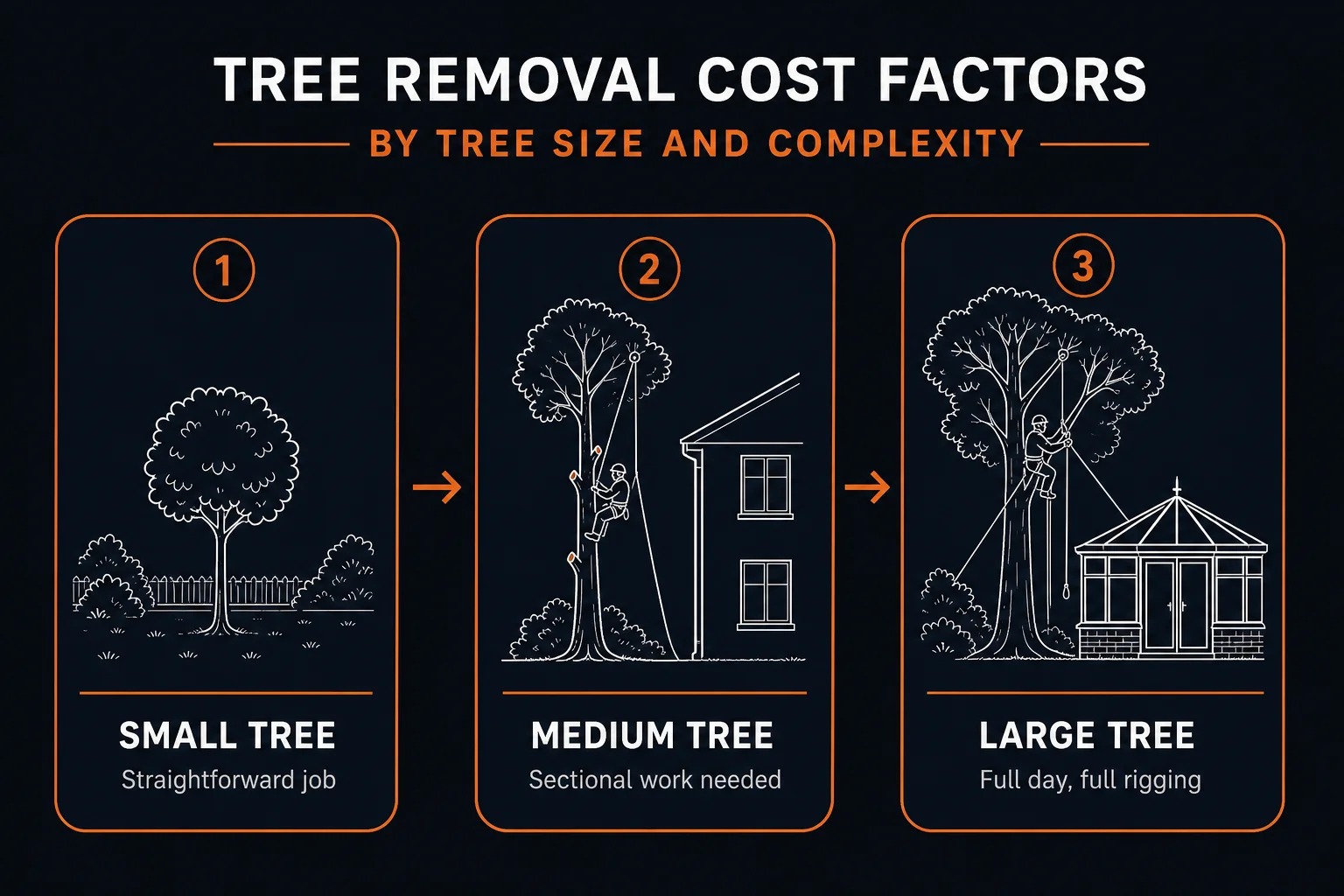
What sets the price of a tree removal
Tree removal is quoted per job. No honest table turns a height into a price, because the same tree on two different sites is two different jobs and the gap between them isn’t small. This is what a working tree surgeon is looking at when he stands under your tree and works out a number.
The page covers UK tree work, and specifically County Durham, North Yorkshire and the Tees Valley, where we work. If you’ve come here looking for a cost per foot, that’s a US convention and it doesn’t translate. UK tree surgeons price the whole job, waste removal included. We don’t publish rates. We quote per job after a site assessment, in writing, with the scope and the exclusions named.
Size and form, not just height
Height is the first number everyone gives us and the least useful on its own. Form decides the work. A slim single-stem birch and a spreading oak of the same height aren’t comparable, because the oak carries several heavy limbs and each one has to be cut, controlled and lowered separately. What we’re measuring is stem diameter at the base, how many major limbs there are and how far they reach, where the weight sits, whether there’s a lean and which way it goes, and whether the tree is one stem or four from ground level. The total volume of wood is what has to be cut, lowered, processed and carried out, and that’s what fills the day.
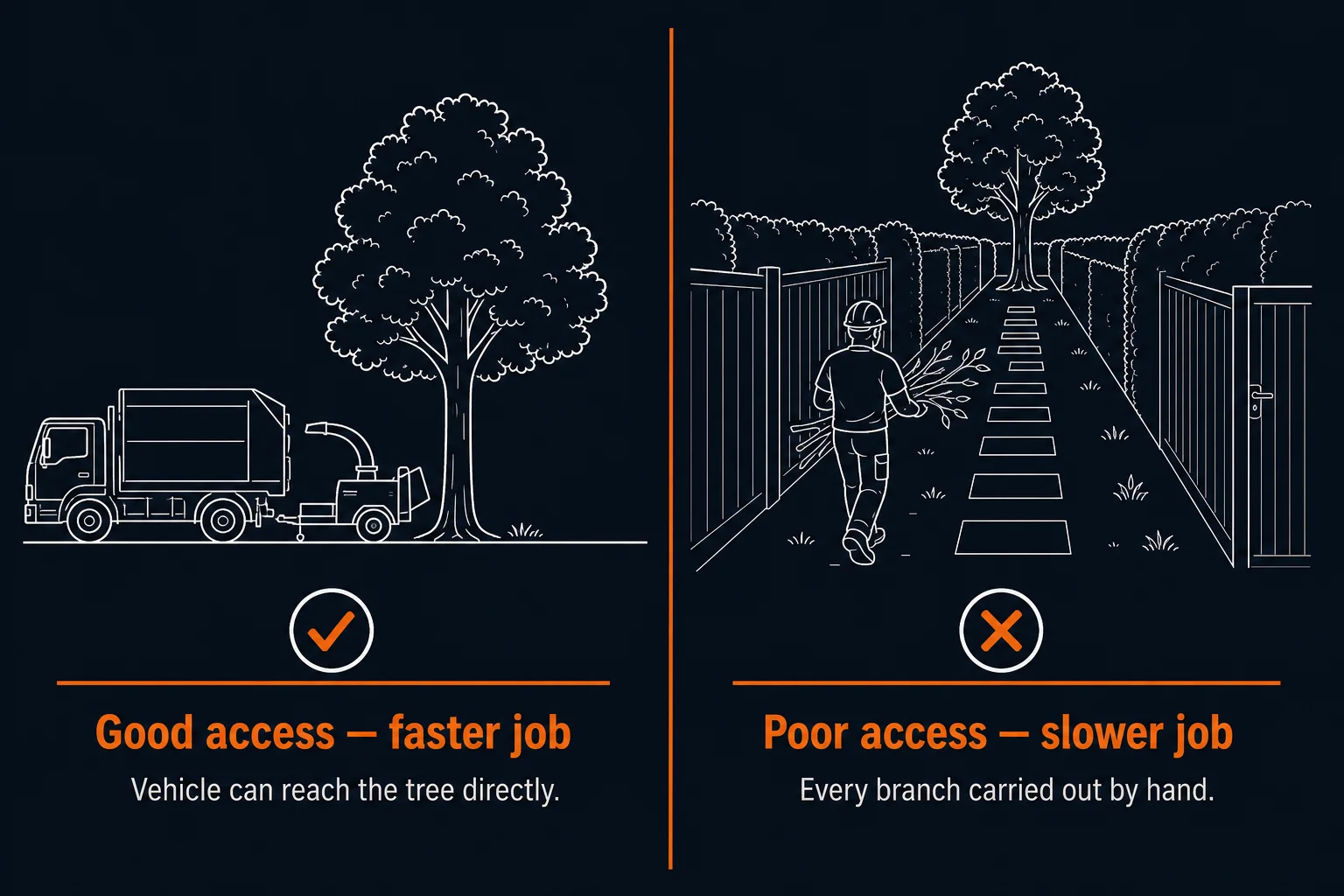
Access and the drop zone
Access is the biggest multiplier after size and the thing homeowners most often under-report. Can the tipper and chipper reach the tree, or do they sit on the road? How wide is the side gate? Is there a step, a terrace, a narrow lane behind a terraced row, a lawn that will rut in February? If everything is carried by hand through a house or up a long garden, the cutting time barely changes and the clearing time multiplies. The drop zone matters as much. Open ground below the tree means sections can be dropped and cross-cut where they land. No drop zone means every piece is roped down under control.
What is underneath the tree
Everything under a tree narrows the options. A conservatory, greenhouse, oil tank, pond, wall, shed, parked car, neighbour's fence or a run of overhead cable rules out the free drop and forces controlled lowering. Gutters and roof tiles are what we’re most often working to protect, and protecting them costs time. Two things change the job outright. Overhead electricity means we don’t proceed until the network operator, Northern Powergrid in this region, has arranged shrouding or an isolation, and that affects the date as well as the price. Work over a public footway or road may need traffic management to Chapter 8.
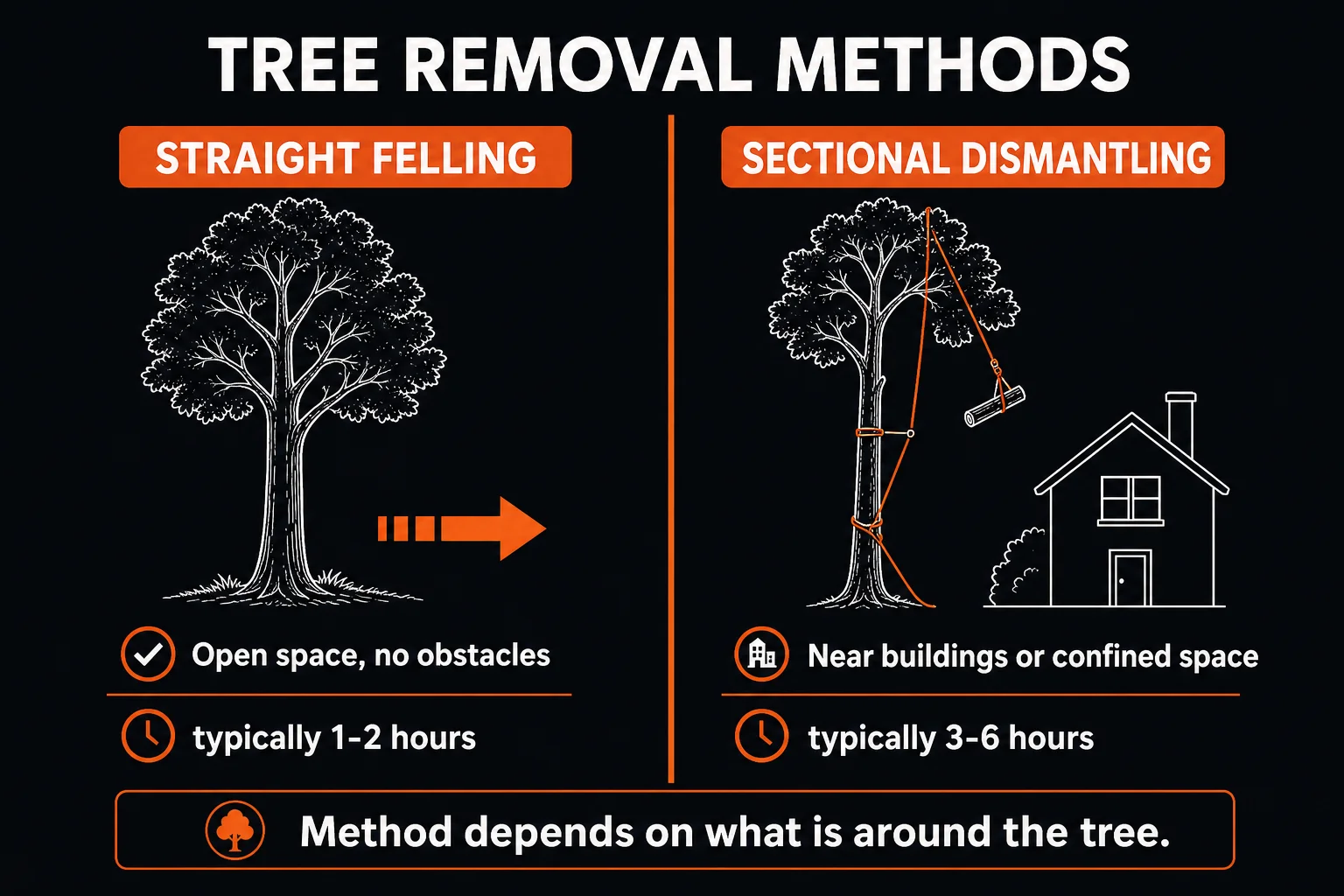
Straight felling or sectional dismantling
This is the largest single fork in a removal quote. Straight felling puts the tree on the ground in one piece, steered with a hinge, wedges and a rope. It needs open ground at least as long as the tree is tall, and it’s quick. Sectional dismantling means a climber works down from the top, lowering limbs and stem sections on rigging one at a time, and on the same tree it can take several times as long. Where decay or dieback makes climbing unsafe, a mobile elevated work platform is hired in and appears as its own line. Our tree felling and sectional dismantling page covers how the method gets chosen.
Removal is also not always the right job. If the problem is light, or clearance over a roof or a boundary, a crown reduction may solve it and leave the tree standing. We’ll say so if that’s what we think.
Waste volume and what happens to the timber
Waste is the part people underestimate most. A dense evergreen produces far more brash than an open-canopy hardwood of the same height, and every load is a round trip with a vehicle and a driver. Trunk wood is the opposite problem. It isn’t bulky, it’s heavy, and a butt section from a mature hardwood often has to be cross-cut where it lies. What you want done with the wood genuinely moves the price, so decide before the quote rather than after the tree is down. Chip blown into a heap and left as mulch saves a tipping run. Logs cut to length and stacked for a wood burner save processing and haulage. Everything taken away is the most expensive option and the most common one.
Time of year
Most planned removal happens between autumn and early spring. Bare trees mean less brash to process, clearer sightlines on structure, and firmer ground in a cold snap. Nesting season is the constraint that catches people out. The Wildlife and Countryside Act 1981 makes it an offence to damage or destroy an active nest while it is in use or being built, so a nest found on site stops work on that tree until the birds have finished. That’s a legal pause, not a scheduling tactic. Storm season is the other pressure, because emergency tree work displaces booked jobs and the diary tightens for everyone.
What affects the quote
A useful comparison starts with the written scope, not a headline figure. Ask each contractor to state the removal method, access assumptions, waste handling, stump work, permissions and exclusions. We assess the tree and site before giving a fixed quote for the agreed scope.
Scope and quotes
Ask whether the quote includes the removal method, waste, stump work and any agreed exclusions. The same tree can require different work on different sites. We quote per job and do not publish rates. See tree removal for the service and stump grinding for separate stump work.
The situations people actually ring about
A tree too close to the house
The most common call, and it almost always means sectional dismantling: no drop zone, a roof and gutters below, often a conservatory or an oil tank. The cost sits in the rigging and the pace, not the cutting. If a surveyor, insurer or engineer has asked for the removal, send that report, because it usually specifies what has to happen. If the tree stands on a boundary, ownership needs settling and both sides should agree in writing first.
A dead ash, or one declining with dieback
Ash with dieback goes brittle, and a dead ash can’t be treated like a live one. The wood snaps instead of bending, so climbing may be ruled out on assessment and a platform or a machine brought in instead. That’s an equipment cost, and it grows the longer the tree stands. Declining ash is the clearest case we see where waiting makes the job dearer rather than cheaper. See ash dieback removal for how the condition is staged.
Restricted access, or no rear access at all
Where the only route is through the house or a narrow gate, we’re pricing the carry, not the cut. Several things bring that down, and all of them are worth raising at quote stage: permission to use a neighbour's driveway, a fence panel taken out and refitted, chip left on site, timber stacked rather than hauled, or road access for a platform where the street allows it.
A protected tree, or one in a conservation area
A protected tree isn’t untouchable, but the route matters and it takes time. Work to a tree with a Tree Preservation Order needs the council's consent before it starts. A tree in a conservation area needs a section 211 notice, and the council has six weeks to respond. We check the address before quoting and we won’t fell a protected tree without the paperwork in place. Two things to budget for: a council may want an arboricultural report to support the application, and consent for removal often carries a replacement planting condition.
Storm damage, and trees already down
Emergency work prices differently because it displaces booked work and often happens in poor light and worse weather. A tree already on the ground is a different job from a damaged standing one, which is why fallen tree removal and emergency tree work are separate services. A wind-thrown tree holds tension in the stem and roots, and releasing it safely is skilled cutting. Make-safe and the later tidy-up are commonly two quoted stages. If an insurer is involved, say so on the first call so the records match the claim.
How species changes the job
Species isn’t a price band, and a table of species against pounds tells you nothing useful. What species changes is the handling: timber weight, brittleness, form and waste volume.
- Ash
- Sound ash is straightforward and makes good firewood. Ash in dieback is brittle and unpredictable, and the assessment decides whether it can be climbed at all. Condition, not species, sets the method here.
- Oak, beech and sycamore
- Dense, heavy timber. A limb weighs far more than it looks, so rigging has to be rated for it and lowered slowly, and the butt is often cross-cut where it falls. Heavy timber is where poor access hurts most.
- Leylandii, Lawson cypress and other conifers
- Light wood, enormous brash volume, so chipping time dominates the day and height and stem count matter more than diameter. They don’t reshoot from brown wood, which is why the conversation usually ends at conifer removal rather than pruning.
- Willow and poplar
- Fast, wet and heavy for their size, with weak unions and frequent decay in old pollard heads. They regrow quickly, so a one-off tidy rarely settles anything near a building.
- Birch, cherry and garden fruit trees
- Usually smaller and quicker, though brittle when old. If the answer turns out to be pruning rather than removal, cherry and plum are usually scheduled for summer to reduce silver leaf risk.
As a side note, most timber from UK garden trees has little resale value beyond firewood, chip or occasional woodworking. One unusual exception is agarwood, the resin-rich heartwood of tropical Aquilaria trees, used to produce oud. It is not something you would normally encounter growing outdoors in the UK, and Aquilaria is covered by CITES trade controls.
Tree and stump together, or tree only
A removal quote covers the tree coming down and the waste agreed in writing. The stump is separate work with separate kit. The grinder has to physically reach it, so access counts twice on the same site, and the price turns on stump diameter, whether it’s multi-stemmed, the width of the root flare, and what sits around it: kerbs, walls, services, fence wire grown into an old boundary stump, buried stone that blunts teeth.
Grinding during the same visit normally beats a second mobilisation, so decide before we quote. Leaving the stump is a legitimate way to spend less, with two caveats: conifer, lime and cherry stumps often sucker, and a decaying stump in a lawn can become a honey fungus source. How deep it needs grinding depends on what happens next, because turf, paving and replanting all want different depths. The detail is on our stump grinding page.
What gets you an accurate quote fastest
- A photo of the whole tree. Far enough back to see the top, with a person, car or door in frame for scale.
- The base of the trunk, and what sits under the canopy. Decay at the base changes the method.
- A photo of the route in. From the road to the tree, including the gate. This answers more pricing questions than the tree photo does.
- The full postcode. It sets the travel and lets us check Tree Preservation Order and conservation-area status before we visit.
- The outcome you want, and what happens to the wood. Removal, reduction or making it safe. All away, chip left, or logs stacked.
- Any paperwork that already exists. A surveyor's or insurer's report, council correspondence, or a neighbour's complaint.
That much is enough to tell you whether the job is straightforward, roughly how long it will take and what method it needs. We won’t put a figure on a tree we haven’t seen when there’s a building, a boundary or a service underneath it, because guessing there’s how quotes get revised on the day. Site visits are free and the written quote is fixed for the scope stated. See getting a tree removal quote without a visit for what can honestly be priced remotely, how long tree removal takes for the time side of it, and our tree removal page for the service itself.
Why two quotes for the same tree differ
Most of the time they aren’t quoting the same job. One includes stump grinding and one doesn’t. One takes every stick away and one leaves the chip. One has priced a sectional dismantle and one has assumed the tree can be dropped whole. One has allowed for a platform and one intends to climb a tree that shouldn’t be climbed. One carries insurance you’ve seen the certificate for.
Compare on the four things that actually vary: the method, the waste, the stump and the cover. Ask for each in writing. A quote that names them is comparable, and a number on its own isn’t. There’s more on this in why tree surgeons charge different prices.
Qualified and insured. NPTC and LANTRA qualified. Constructionline Gold certified. £10M public liability insurance. Written fixed-price quote after a site assessment, with the scope and exclusions named.
Common questions
- How much does tree removal cost in County Durham?
- We quote per job after a site assessment rather than publish a rate, because the same tree prices differently on two sites. Size and form, access, what sits under the tree, the felling method, waste volume and any protected status all move the figure. Send photos and a postcode and we’ll tell you what the job involves.
- What affects the cost of removing a tree most?
- Access, once the tree is bigger than a garden sapling. If the chipper and tipper can reach the tree the work flows. If every branch and log is carried through a house or up a long garden, the clearing time multiplies while the cutting time stays the same. After access comes what is underneath, because that decides whether sections can be dropped or have to be roped down.
- Do you publish tree removal rates?
- No. We quote per job after a site assessment, because size, access, what sits under the tree, the removal method and waste handling vary too much for a rate to be honest. What you get is a fixed written quote for the agreed scope. Ask any contractor to state the method, the waste, the stump and the exclusions so the quotes can be compared.
- Why do tree surgeons charge different prices for the same tree?
- Usually because they have quoted different jobs. Check whether each quote includes stump grinding, whether waste is taken away or left, whether it prices a sectional dismantle or assumes the tree can be felled whole, and what public liability cover is held. Ask for all four in writing before comparing numbers.
- Can you quote for tree removal without visiting?
- For a straightforward tree with clear access, photos and a postcode are often enough to describe the job and the method. We won’t price blind where there’s a building, boundary or service under the tree. Site visits are free and the written quote is fixed for the scope stated.
- Does the stump come out as part of tree removal?
- No. Grinding the stump is separate work with separate machinery, priced on stump diameter, root flare, whether it’s multi-stemmed and what sits around it. Doing it during the same visit is normally better value than a second mobilisation, so decide before the quote is written.
Got a tree that needs work?
We review the situation. We give you a fixed quote. No hidden costs. What we quote, you pay.