
For straightforward trees, yes. You can get a tree removal quote without someone visiting the site. Send two or three photos and we’ll give you a ballpark figure by phone or email. For complex jobs, we need to see the tree in person. This guide explains which jobs can be quoted from photos, what to send, and how to avoid the cheap-quote trap.
The key distinction is between a ballpark figure and a written quote. A ballpark tells you what the job will probably cost. A written quote is what we’ll actually charge, agreed before any work starts. Both are free. The difference matters because it protects you.
When a photo quote works
Photos work for trees that are straightforward to assess. The tree is visible, the access is obvious, and the work is standard. For those jobs, a photo gives us enough to price it confidently.
Typical jobs we can quote from photos:
A small tree in an open garden. If the tree is clearly visible, away from buildings, and reachable with vehicle access, we can price a fell and tidy from a couple of photos.
A hedge or conifer needing a reduction. If we can see the height, the width and what is around it, we can give you a figure for cutting it back.
A straightforward removal where the plan is obvious. Fell it, process it, take it away. When nothing complicates that plan, the photo method is fine.
The photo method saves you time. No waiting in for a visit, no scheduling around your day. Send photos when it suits you, get a figure back, and decide if the number works before we arrange anything else.
What to send for an accurate photo quote
The quality of the quote depends on the quality of the photos. Two or three photos from different angles, with something in the frame for scale, is the difference between a useful answer and a guess.
Take a photo of the whole tree. Stand far enough back to get the full tree in frame, from the base to the top. This shows the size.
Take a photo of the base. The bottom of the trunk and the ground around it. This shows the root area and what is at ground level.
Take a photo of the surroundings. Show where the tree sits in relation to the house, the fence, a greenhouse, a conservatory, or power lines.
Give everything scale. A person standing next to the tree, a car, a fence panel, a door. Without scale, a 10 foot tree and a 30 foot tree look the same in a photo.
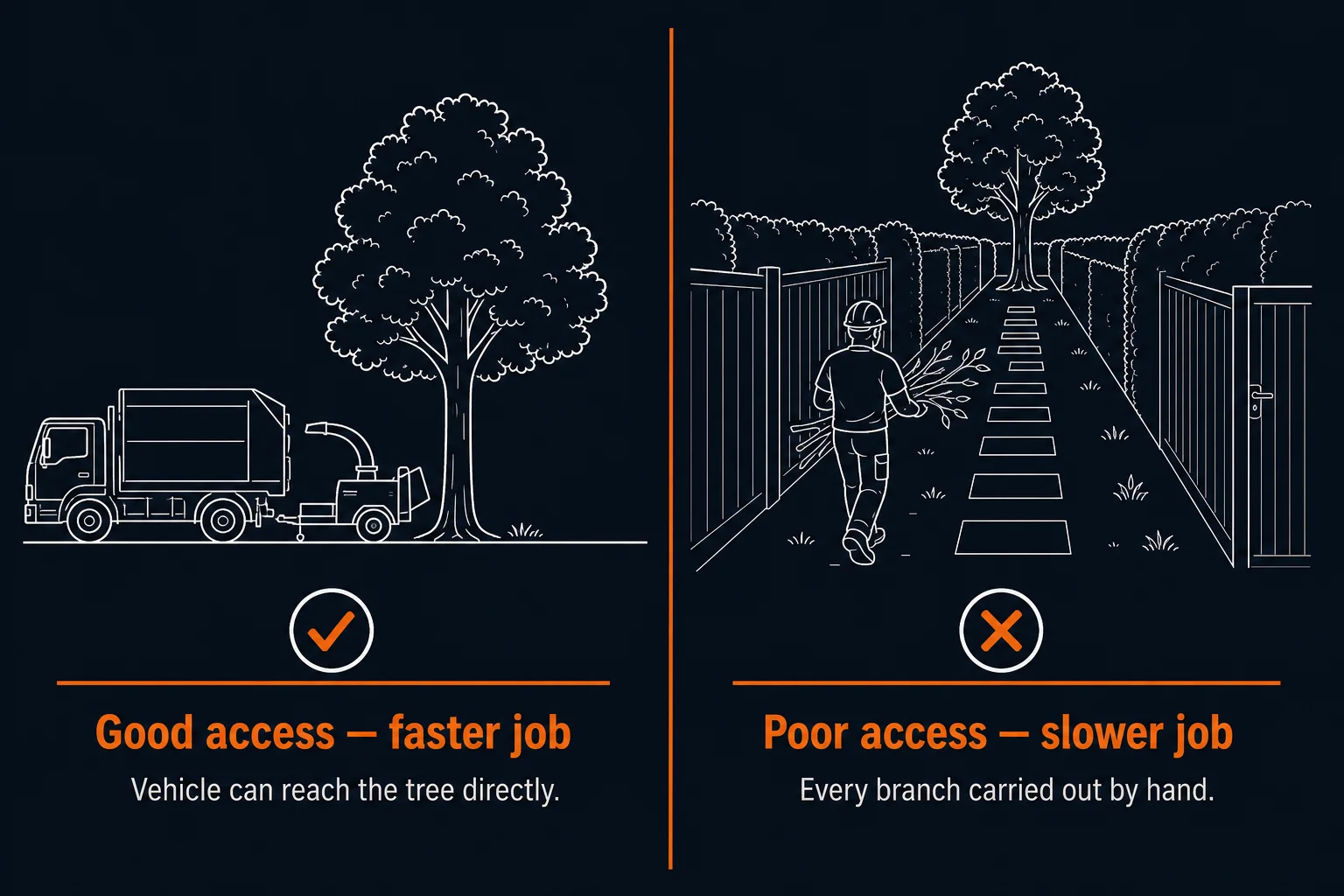
Tell us about access. Can our truck and chipper drive up to the tree, or is there a side gate, a long garden, or no passage at all? Access is the single biggest price variable, and it never shows up properly in a photo.
Tell us what you want done with the wood. Everything taken away, logs left, stump grinding included or not. These change the price, so mention them up front.
When we need to visit instead
Some jobs can’t be priced honestly from photos. We don’t quote blind on work where getting it wrong could put someone or something at risk.
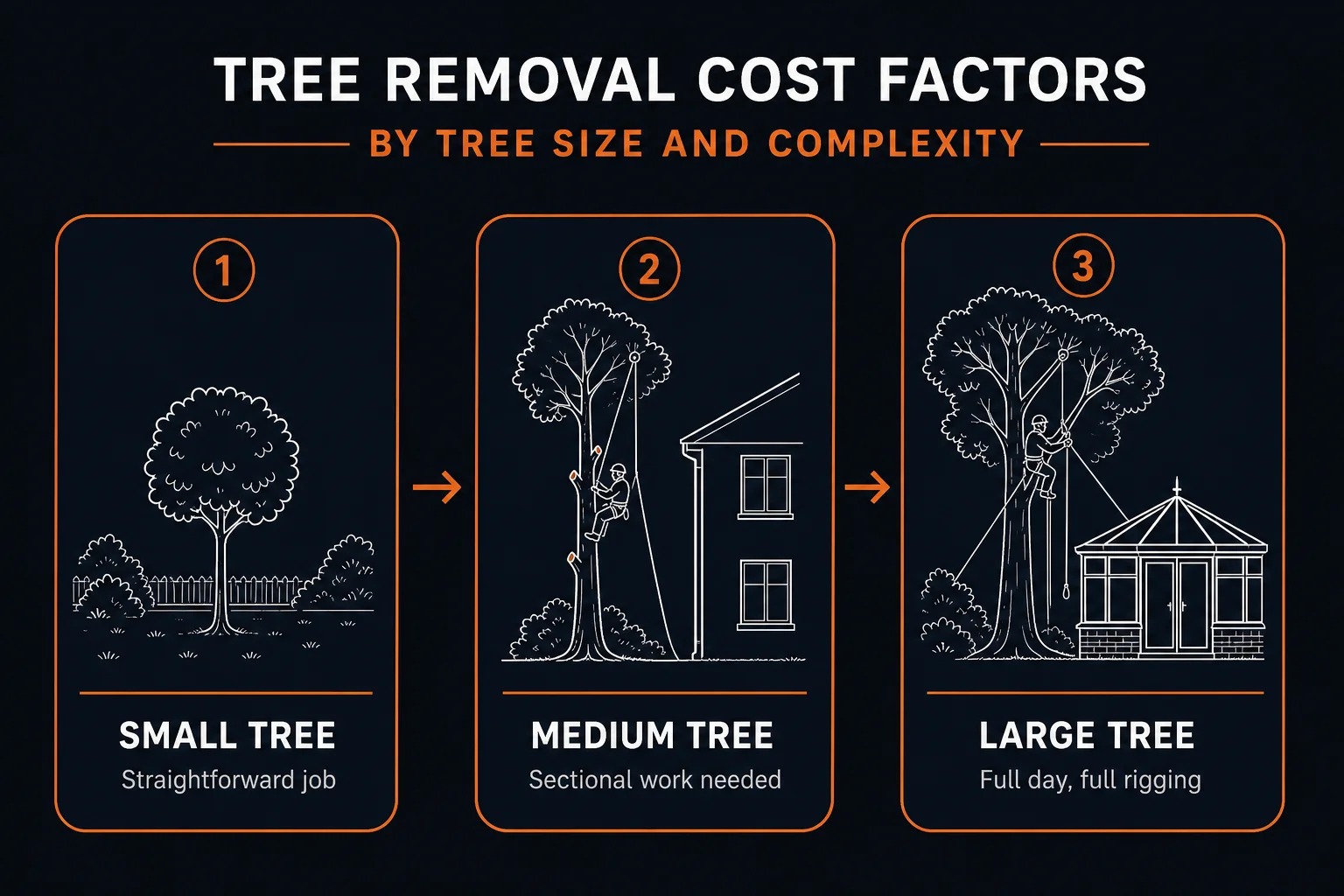
Large trees near buildings. A mature tree close to a house, conservatory, or boundary wall usually needs sectional dismantling. That means climbing, rigging and lowering every piece. We need to see the setup in person to price it.
Poor or unknown access. If we can’t see how the equipment gets to the tree, the visit is the only way to price the job properly. The difference between driveway access and no side passage can double the price.
Dead, damaged or dangerous trees. A dead or diseased tree is unpredictable. We need to look at the condition, the structure and the safe way to work it before we commit to a figure.
Trees near power lines. Work near power lines means coordinating with the network operator. That adds time and cost, and it can’t be assessed from a photo.
Anything where we can’t see enough. If the photos don’t show what we need, we’ll say so and offer a free site visit. That isn’t a sales tactic. It’s how we avoid quoting the wrong number.
Ballpark figure versus written quote
The ballpark and the written quote do different jobs. Understanding the difference stops surprises.
Ballpark figure. A range we give from photos, usually over the phone or by email. It tells you whether the job is in your budget. It isn’t a fixed price, and we’re clear about that. For a sense of the figures involved, see the tree removal cost guide.
Written quote. A fixed price we give after a site visit. It’s what we’ll charge, in writing, before any work starts. What we quote, you pay. No hidden costs.
The ballpark gets you to the decision point. The written quote is the number you commit to. For straightforward jobs, the ballpark and the final quote will be close. For complex jobs, the visit can change the figure, which is exactly why we don’t quote those blind.
Free quote versus cheap work
There’s a difference between a free quote and cheap work, and confusing the two costs people money.
A free quote simply means you aren’t charged for the assessment. Every quote we give is free. The site visit is free, the photos are free, and there’s no obligation to go ahead. That’s normal in this trade.
Cheap work is different. A quote that’s far below every other quote is usually missing something. Insurance, waste removal, qualifications, or an understanding of what the job actually involves. The cheapest quote is a gamble, and the gamble is yours. See why tree surgeons charge different prices for the detail.
When you compare quotes, compare what is included, not just the number. Ask what happens if the job turns out to be harder than expected. Ask to see the insurance certificate. A firm that quotes from a photo and commits to a fixed price for a complex job is either very confident or not telling you something.
What happens after you send photos
The process is simple and it stays in your hands:
1. Send the photos. Email them to us, or send them over WhatsApp. Include the details above and any questions you have.
2. Get a ballpark figure. We come back with a range for the job. If it works for you, we go to the next step. If it doesn’t, no harm done.
3. Book a free site visit. For a written quote, we visit, measure up, and check the access. The visit is free and there’s no obligation.
4. Receive a written quote. A fixed price in writing. What we quote, you pay.
Time is part of the price too. A small tree with good access takes two to three hours. A medium tree needing sectional work takes half a day. A large tree in a confined space takes a full day or more. See how long tree removal takes for the detail.
Before you commit to any removal, check whether the tree needs permission. If it is in a conservation area or covered by a Tree Preservation Order, you need consent before work starts. See whether you need permission to prune a tree, and the GOV.UK guidance on tree preservation orders.
For the full picture on pricing, read the tree removal cost guide. It covers what determines the price, what the published figures are worth today, and where costs are heading to 2030.
Got a tree that needs work?
We review the situation. We give you a fixed quote. No hidden costs. What we quote, you pay.