
What the high hedges law actually covers
Two things get said about leylandii and both are wrong. One is that there’s a legal height limit. The other is that a council can order a hedge cut down. Knowing what the law does say usually changes what people decide to do about the hedge.
The High Hedges provisions sit in Part 8 of the Anti-social Behaviour Act 2003. They apply in England and Wales only. Scotland and Northern Ireland have separate legislation, so guidance written for them doesn’t transfer.
The tests a complaint has to meet
The provisions don’t cover every tall hedge. To fall within them, the hedge needs to be a line of two or more trees or shrubs, mostly evergreen or semi-evergreen, more than two metres in height, and acting as a barrier to light or access to a domestic property. Height is measured from the ground level where the hedge grows, which is worth agreeing early on a sloping boundary. The officer takes their own measurement.
Read those tests together and several common complaints fall outside them. A single large conifer isn’t a high hedge, however tall it is. A hedge that blocks a view rather than light isn’t covered, because a view isn’t protected. Roots, leaves in gutters, overhanging branches and boundary arguments are all real problems, but they’re dealt with in other ways, not through a high hedges complaint.
Two metres is a threshold, not a limit
Nothing in the Act says a hedge must be kept at or under two metres. The figure is the point below which a complaint can’t be made at all. Above it, the council still has to decide whether the hedge is genuinely unreasonably affecting the enjoyment of the neighbouring property. Plenty of hedges over two metres are perfectly lawful and stay exactly where they’re.
What a remedial notice cannot do
If the council upholds a complaint it issues a remedial notice to the hedge owner, setting out what has to be done and by when. Two limits on that notice matter more than anything else here, and they’re the ones both sides get wrong.
A remedial notice cannot require the hedge to be reduced to less than two metres in height. Two metres is the floor. A notice asking for one and a half metres, or for the hedge to be taken down to fence height, is asking for something the Act doesn’t allow.
A remedial notice cannot require the removal of the hedge. The council has no power to order a hedge grubbed out, and it can’t order individual trees within the hedge taken out as a way of achieving the same thing. If your neighbour is telling you the council will have your leylandii removed, that isn’t how this works.
What a notice can do is require the initial work that puts the problem right, and require ongoing action to stop it recurring, which in practice means keeping the hedge at the height the notice sets. That’s a maintenance obligation, and it is where many hedge owners end up: removing nothing, just holding a height.
The order the process runs in
The council expects you to have tried first
A high hedges complaint is a last resort and councils treat it that way. You’ll be asked for evidence that you tried to sort it out with your neighbour directly, usually in writing, and a complaint can be turned away if you haven’t. Keep copies of what you sent and any reply. This isn’t a formality the council waives because relations have broken down.
Then, in order
- Written complaint. You submit the council complaint form with your evidence and pay the fee.
- The council decides whether to take it on. It can reject a complaint that falls outside the tests, or where no attempt has been made to resolve it directly.
- The hedge owner is notified and invited to respond. Both sides put their case, and the hedge owner should respond rather than ignore it.
- Site visit. An officer measures the hedge and assesses the effect on light and access to the property.
- Decision. The complaint is upheld or it isn’t, with reasons in writing.
- Remedial notice. If upheld, the notice states the work, the compliance period and any ongoing maintenance, within the two limits above.
- Appeal. Either side can appeal the outcome. The decision letter states where the appeal goes and the deadline, which is short.
- Enforcement. Ignoring a notice that has taken effect is an offence and the council can pursue it through the courts.
None of this is quick. Expect months rather than weeks from complaint to notice, and longer if it is appealed.
The fee is set locally and varies
Each council sets its own fee for a high hedges complaint, and reported figures vary widely between authorities. There’s no national figure, so ignore any article that gives you one. Check what your own council charges, and ask two more questions while you’re there: whether the fee is refundable if the complaint isn’t upheld, and whether any reduction applies to you.
Keeping a hedge compliant instead of removing it
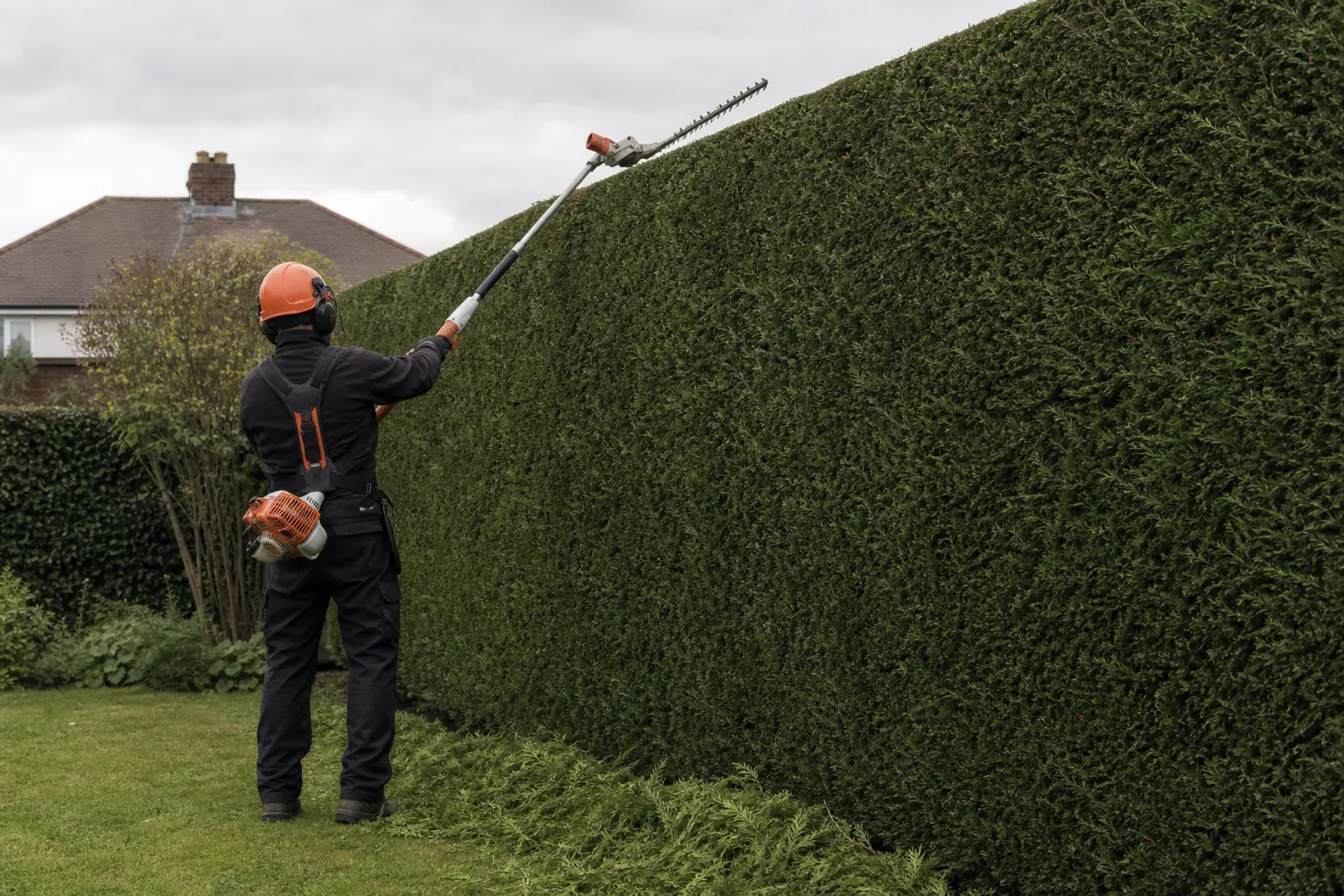
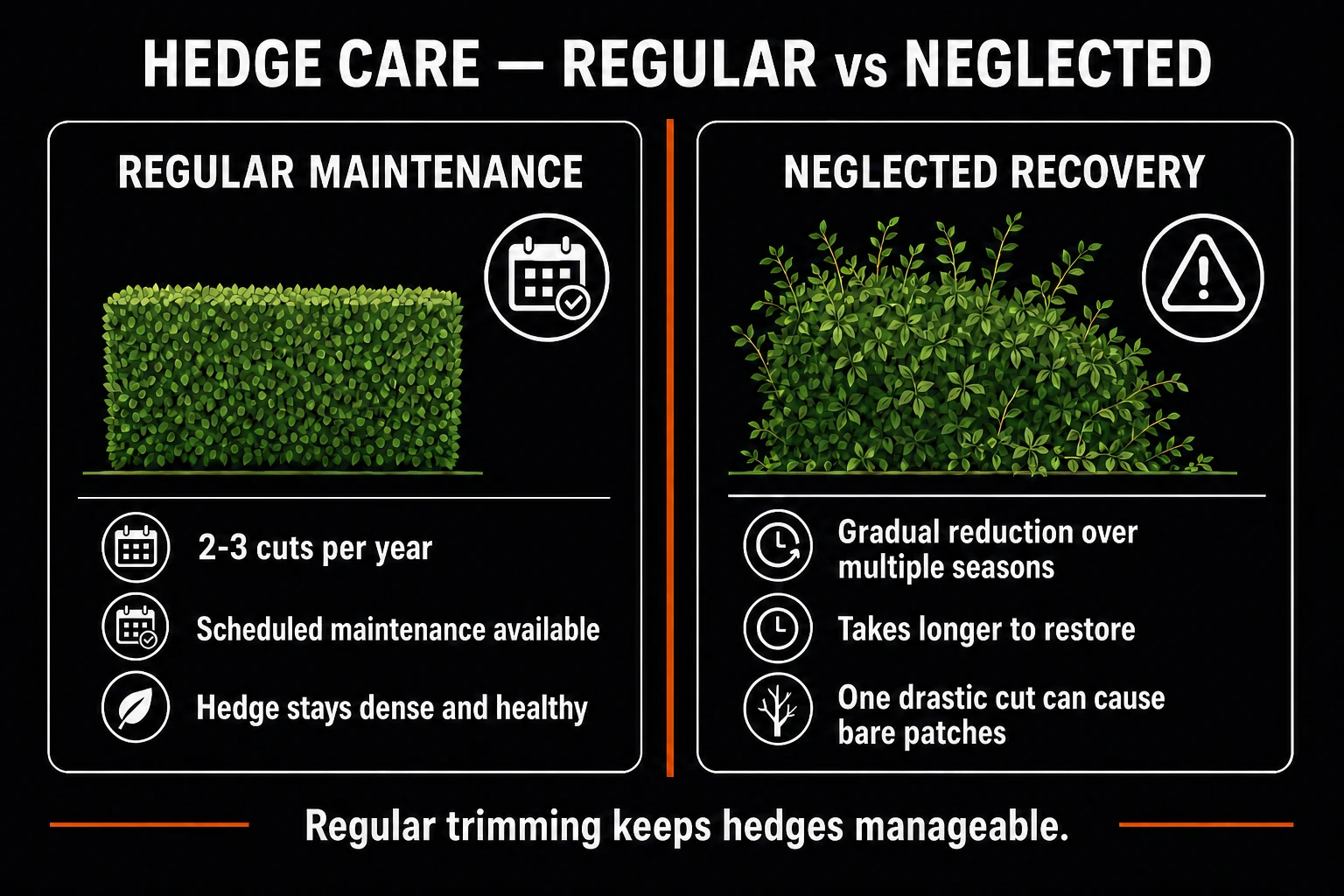
Almost everything written about leylandii and the law jumps from complaint straight to removal. For a lot of hedges that skips the obvious answer, which is to reduce it once and then hold the height.
Where the height you can hold actually is
Here is the part the legal guides leave out. A leylandii carries its green growth on the outer shell of the tree, and the brown wood behind it has no dormant buds. Cut into that bare wood and it stays bare, permanently. So the lowest sensible height for a leylandii hedge isn’t two metres because the Act mentions two metres. It’s wherever the lowest live green growth still is.
If the green stops well above the height you’ve been asked to reach, you have a straight choice: accept a brown top or side that won’t recover, or take the hedge out and plant something you can keep at the height you want. Both are legitimate. What you cannot do is cut into old wood and expect it to green over, and no council notice changes that.
What holding a height involves
A conifer hedge kept on a regular cycle is ordinary garden maintenance. One left for fifteen years is a tree job. Getting from the second state to the first is the expensive part, and it’s often best done in stages. After that, cutting to the same line each year keeps the green shell intact and keeps everyone out of the council process. See hedge care and hedge trimming in Durham for how that’s scheduled.
If removal is the right answer
Sometimes it is. The hedge is too close to the house, the green starts too high to give a usable height, the row is failing, or you want the space and the light back. Removal is your decision as the owner, and it isn’t something the council can require of you.
What removal involves, how staged reduction compares, the option of leaving stems standing at height rather than going to ground level, stump and root handling, and why waste volume and access drive the cost are all set out on our conifer and leylandii removal page. Our published staged conifer removal case study records 21 conifers removed in stages with the final stems left at 6 to 8 feet. It’s North East domestic work, not a legal precedent.
The two checks that do apply to the work
Whatever the high hedges position, cutting or removing a hedge has its own constraints. Under the Wildlife and Countryside Act 1981 it is an offence to damage or destroy an active nest while it is in use or being built, and a dense conifer row is a favourite nesting site, so the hedge is checked before work starts. Separately, a conifer can be covered by a Tree Preservation Order, and in a conservation area a section 211 notice with a six-week period applies before work goes ahead. Our guide to domestic hedge cutting rules covers timing, including why the agricultural hedgerow cutting dates don’t apply to a garden boundary.
If you’re dealing with a hedge on either side of this and want a practical view of what can be cut, send us the hedge details for a written scope. We’ll tell you where the green stops, which is usually the fact the argument turns on.
Common questions
- Is there a legal maximum height for a leylandii hedge?
- No. Two metres is the threshold below which a high hedges complaint can’t be made, not a height limit. A hedge over two metres is lawful unless a council decides, on a complaint, that it unreasonably affects the neighbouring property.
- Can the council order my leylandii hedge to be removed?
- No. Under Part 8 of the Anti-social Behaviour Act 2003, in England and Wales, a remedial notice cannot require removal of the hedge and cannot require it to be reduced below two metres. It can require work to put the problem right and ongoing maintenance to keep it there.
- What does a high hedges complaint cost?
- Each council sets its own fee and reported figures vary widely between authorities, so check your own council rather than relying on a national figure. Ask whether the fee is refundable if the complaint isn’t upheld.
- Do I have to speak to my neighbour before complaining?
- Councils expect evidence that you tried to resolve it directly first, normally in writing, and can refuse a complaint if you haven’t. Keep copies of what you sent and any response before you submit the form.
- Should I reduce the hedge or take it out?
- It depends where the lowest live green growth is. A conifer won’t regrow from bare brown wood, so if the green stops above the height you need, a reduction leaves a permanent brown face and removal with replanting may give a better boundary.
Got a tree that needs work?
We review the situation. We give you a fixed quote. No hidden costs. What we quote, you pay.