
Tree Pollarding
Pollarding is a repeating cycle started on a young tree, not a one-off cut. What we can and can’t pollard across County Durham and North Yorkshire.
Send photos of the whole tree and its base, and tell us whether it has been cut this way before and roughly when. We’ll say honestly whether pollarding is the right operation, then quote in writing.
What our customers say
“I was recommended Ross to cut down and trim a large conifer hedge.”
“He came out quickly after getting in contact to assess what needed doing and provide a quote.”
“Very professional and educated me what was the best way to do the job.”
“He was quick, efficient and did a great job of clearing away.”
“Will definitely be using again and recommending to others.”
- NPTC qualified
- LANTRA qualified
- £10M public liability insurance
- BS3998 standard
Pollarding is a cycle, not a single cut
Pollarding is a system of pruning that starts on a young tree and then repeats. The main stems are cut back to a chosen framework at a set height, the tree answers with a flush of new shoots, and those shoots are cut back to roughly the same points on a regular return. Over the years the cut points thicken into a head, the permanent trunk below it carries no long limbs, and the tree settles into a form it can hold for a very long time. Some of the oldest trees in the country are pollards, which tells you the practice doesn’t harm a tree that has been managed this way from the start.
We establish pollards on suitable young trees and maintain existing pollards across North Yorkshire, County Durham and the Tees Valley. Send a photo and any history of previous work so we can assess which approach is suitable. Cutting back a mature tree that has never been pollarded is a different operation and may cause lasting damage.
What the work includes
Starting a new pollard
- The framework height, agreed first
- Where the head will sit, set against the reason for the work: above livestock browsing, below a roof line, under a wayleave, clear of a sightline. That height is effectively permanent once the tree responds to it.
- Small cut diameters
- The first cuts are made while the stems are still small enough for the tree to seal them. That’s the entire reason pollarding begins young rather than late.
- A stated return interval
- Written into the quote, so the next visit is planned rather than assumed. A pollard left too long stops being a pollard, and the problem it becomes is a bigger job than the cycle it replaced.
Cutting an established pollard
- Regrowth back to the head
- Shoots cut just above the previous cut points, leaving the swollen head itself intact. Cutting into the head is where an existing pollard gets damaged.
- Head and union inspection
- Old cut faces checked for cavities and decay while we’re already up there, and dead material cleared. See deadwood removal.
- Arisings handled
- Brash chipped or taken away, cordwood cut to length and stacked if you want it, and the ground raked off. On a bank or a ditch line that includes keeping cut material out of the channel.
Why a mature tree that has never been pollarded can’t be pollarded now
This is the most useful thing on the page. If a large established tree with a full crown is cut back to its main stems, that’s topping, not pollarding, whatever the quote calls it. The difference isn’t the height or the saw. It’s the diameter of wood being cut and whether the tree has ever been asked to respond that way before.
A young tree cut at three metres loses stems the thickness of a wrist. A sixty-year-old lime cut at the same height loses stems the thickness of a leg, and it’s left with several open faces too large to seal, in the parts of the structure carrying everything above them. Decay works down from those faces. Whatever regrowth appears is anchored in the outer wood around a rotting cut, so a decade later there’s a heavy new crown standing on a bad platform. BS 3998:2010 puts it plainly: pollarding is started early in the life of a tree, and cutting a mature tree back to its main stems is a different operation with different consequences.
What to do with that tree instead
Usually a crown reduction, which makes a tree smaller by shortening branches back to growth points that can take over, without opening up the main stems. If the real problem is shade, that’s crown thinning. If it’s clearance underneath, crown lifting. If the tree is simply in the wrong place for the size it has reached, the honest conversation is tree removal, and we would rather have that conversation than take money for work that shortens the life of the tree. The longer comparison is in our article on crown reduction versus topping.
Restoring a lapsed pollard
A lapsed pollard is a tree that was pollarded and then left. Thirty or forty years of uncut growth puts limbs of real size on old cut points that were never meant to carry them, and those points are often hollow behind the bark. When they go, they go at the union rather than out along the limb. Old field boundaries, becks and ditch lines in this patch carry plenty of them, along with estate limes that stopped being cut when the labour that cut them went.
Restoration is staged work, not one visit. Taking a lapsed pollard straight back to its old head removes nearly all the leaf area at once and can kill a tree that had stood for two centuries. We shorten the limbs over several visits spread across years, leave live growth on every limb at each stage, and return once the tree has shown what it can produce. Some are too far gone to bring back into cycle, and the honest answer there’s to reduce the risk without pretending the cycle can be restarted.
Veteran trees and what lives in them
Old pollards are habitat. The cavities behind those heads hold bats, and bats and their roosts are protected, so if there’s evidence of a roost the work stops until an ecologist has looked at it. Where a lapsed pollard is a veteran tree, the aim is usually keeping it standing rather than getting it productive again, and that decision belongs in a written programme rather than a single quote. See tree surgery for farms and estates.
Species that take pollarding, and species that can’t
The whole practice rests on one question: can the species put out new shoots from old wood after the cut? Willow, poplar, lime, plane, hornbeam and ash do it readily, which is why the traditional pollards in this country are mostly those trees. Oak, sweet chestnut, field maple and alder were worked this way historically too, more slowly and on a longer return.
Conifers
Most conifers can’t do it at all. Leyland cypress, spruce, pine and larch carry live growth on the outer shell of the crown only and won’t regenerate from bare old wood, so a pollarding cut leaves a brown skeleton that stays brown. Yew is the exception among the conifers grown here, because it does regenerate from old wood. For an overgrown conifer or a leylandii row the realistic options are a reduction that stays inside the green growth, or conifer removal.
When we won’t commit on a species
Individual trees vary more than a species list suggests. Vitality, age, how the tree handled its last cut and how much sun the head gets all change the answer. Where we aren’t confident a particular tree will respond, we say so, and we would rather cut part of the crown and watch what happens for a season than commit a whole tree to a cycle it may not survive.
Timing and the return interval
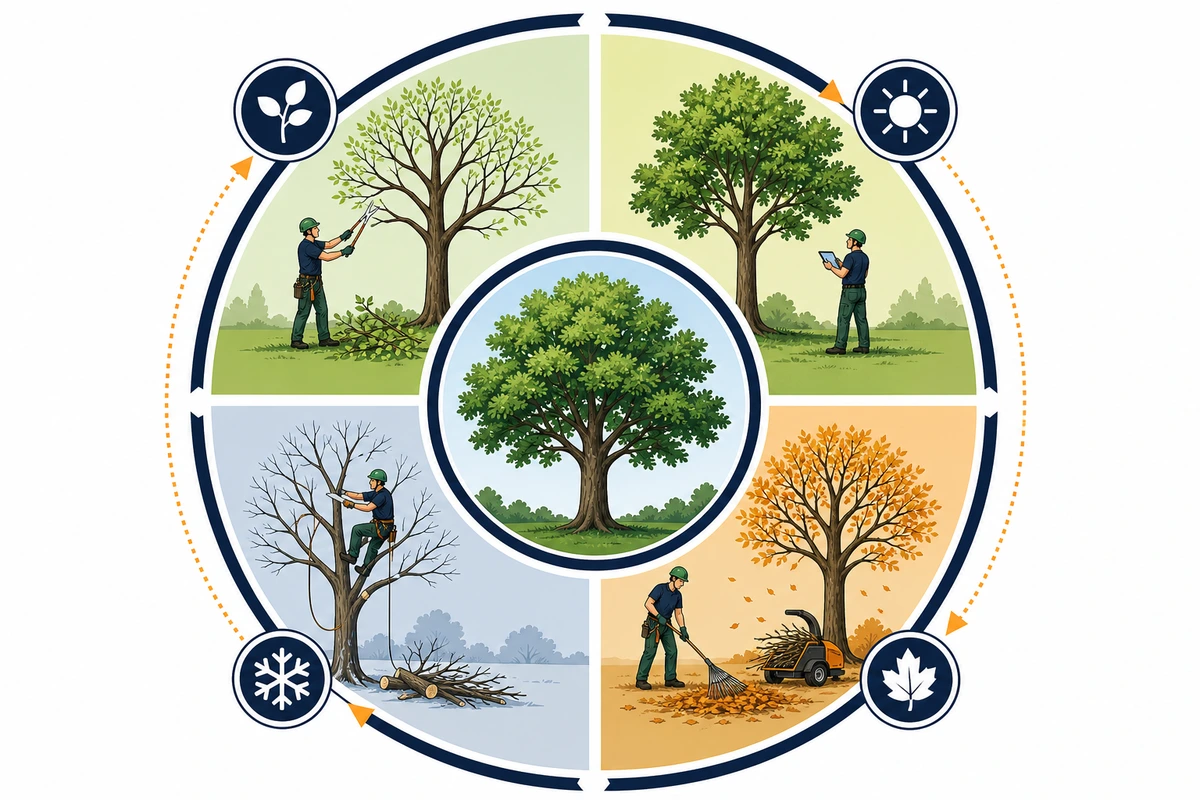
Willow on a short cycle for bank work or basketry may be cut every year or two. A farm or amenity willow on a beck usually sits at three to five years. Lime, plane and hornbeam heads take a longer interval again. What sets the figure is what the tree is for and how fast the head thickens, not a calendar. Nesting stops the work whatever the interval says: the Wildlife and Countryside Act 1981 makes it an offence to damage or destroy an active nest while it is in use or being built, so we check before cutting and reschedule if we find one.
Willows on becks, estate limes and poplar belts
Pollarding here is mostly rural rather than municipal. Willows along becks, ditches and field drains, where an uncut tree eventually falls into the channel it’s meant to hold. Lime avenues on estates, kept to a height that keeps the avenue readable. Poplar in shelterbelts and behind farm buildings, where the species drops limbs and height control is the point. The cut is what separates pollarding from coppicing: coppice at the base, pollard above browsing height, which is precisely how pollards survived on grazed land and coppice stools didn’t.
Because the return is predictable, pollarding is one of the few tree operations that genuinely belongs in a recurring programme rather than a reactive call-out. Several trees on one visit at a known interval costs less and treats the trees better than waiting until one becomes a problem, which is why this work usually sits inside commercial tree maintenance or a domestic tree maintenance cycle.
Protected trees and watercourses
Work to a tree with a Tree Preservation Order needs consent, and a tree in a conservation area needs a section 211 notice with a six-week period first. Continuing a cycle somebody started decades ago isn’t automatically outside that, so we check the address before booking. On a watercourse there’s a second question: cut material must not be left where it can wash in and block the channel, and clearing an obstruction from your own bank falls to you as the riparian owner. Work in or beside a watercourse can also need consent of its own, separate from anything to do with the tree, so on a main river or a maintained drain we check with the drainage authority or the Environment Agency before the visit rather than after it.
What drives the price
We quote per job after a site assessment. The figure follows the number of trees and how close together they stand, the size of the regrowth coming off, the height of the head and whether we climb it or reach it from a machine, ground conditions underneath, brash volume and somewhere for a chipper to stand, whether cordwood is stacked or taken away, and any traffic control where the trees stand on a roadside. A soft beck bank in February is a different job from a hard verge. A run of willows in one visit costs far less per tree than the same trees one at a time, which is the main argument for planning the cycle rather than reacting to it.
What isn’t included
Pollarding isn’t a general way of making a big tree smaller and we don’t sell it as one: see crown reduction, crown thinning, crown lifting and the full range on our tree pruning page. Felling and stump work are quoted through tree removal and stump grinding. Hedge work sits under hedge care. Work on a protected tree without consent isn’t included, and neither is topping a mature tree and calling it a pollard.
Pruning standards. NPTC and LANTRA qualified. Constructionline Gold certified. £10M public liability insurance. Work specified to BS 3998, with the return interval stated in writing.
What customers ask
Common questions
Can you pollard a mature tree that has never been pollarded?
No. Cutting a big established tree back to its main stems is topping, not pollarding, and it leaves wounds the tree can’t seal, followed by weakly attached regrowth on decaying cut points. Pollarding is started on a young tree while the cut diameters are small. For a mature tree that has outgrown its position, a crown reduction is usually the right answer.
How often does a pollard need cutting?
It depends on the species and what the tree is for. Willow on bank or basketry work can be cut every year or two, a farm willow on a beck typically every three to five years, and lime, plane or hornbeam heads on a longer interval again. We state the interval in the quote so the next visit is planned rather than left until the tree becomes a problem.
Can an old pollard that hasn’t been cut for decades be brought back?
Often, but only in stages. An uncut pollard carries heavy limbs on old cut points that are frequently hollow, so we shorten them over several visits across years, leaving live growth on each limb every time. Cutting one straight back to its old head in a single visit can kill a tree that had stood for centuries. Some are too far gone, and we’ll say so.
Can conifers be pollarded?
Almost never. Leyland cypress, spruce, pine and larch carry live growth only on the outer shell of the crown and won’t regrow from bare old wood, so the cut leaves a brown skeleton permanently. Yew is the exception among the conifers grown here. For an overgrown conifer, reduction inside the green growth or removal are the realistic options.
Do I need permission to pollard a tree?
You do if the tree has a Tree Preservation Order, and a tree in a conservation area needs a section 211 notice with a six-week period before work starts. Continuing an existing cycle isn’t automatically exempt from either. We check the address and the proposed work before booking and explain which route applies.
Ask about a pollarding cycle
Send photos of the whole tree and its base, and tell us whether it has been cut this way before and roughly when. We’ll say honestly whether pollarding is the right operation, then quote in writing.