Deadwood Removal
Deadwood removal and tree safety inspection across County Durham and North Yorkshire. What we take out, what we leave for habitat, and why it matters.
Send photos of the whole tree, the branches you’re worried about and what sits underneath them. We’ll arrange an inspection and tell you what genuinely needs to come out.
What our customers say
“I was recommended Ross to cut down and trim a large conifer hedge.”
“He came out quickly after getting in contact to assess what needed doing and provide a quote.”
“Very professional and educated me what was the best way to do the job.”
“He was quick, efficient and did a great job of clearing away.”
“Will definitely be using again and recommending to others.”
- NPTC qualified
- LANTRA qualified
- £10M public liability insurance
- BS3998 standard
Deadwood removal from a standing tree
Deadwood removal is the selective removal of dead, broken and hanging wood from a tree that’s otherwise staying. It’s done for one reason. Dead wood falls, and where it falls onto a path, a drive, a car park, a play area or a road, the person who owns or manages that land is the one who has to answer for it. The tree itself very rarely needs the work.
Most enquiries come from one of two places. Either somebody has looked up and seen bare grey branches over something that matters, or a surveyor, insurer or managing agent has flagged a tree and asked for the work to be done and recorded. Send photos of the whole tree and what sits beneath it.
What a deadwood removal visit includes
- Crown inspection
- The crown looked at from inside it, not judged from the lawn. Climbing finds broken stubs, torn unions and hung-up wood that can’t be seen from the ground.
- Removal of dead and hanging wood
- Dead branches, snapped stubs and limbs lodged in the crown taken out, and lowered on ropes where they can’t be dropped clear.
- Clean cuts at the collar
- Cuts made just outside the branch collar so the tree can seal them. We don’t cut flush and we don’t leave stubs.
- A note of what was found
- What was removed, what was left and why, and anything worth looking at again. On a managed site that note becomes part of your records.
What deadwood actually is
Natural shedding
A healthy tree kills off its own lower and inner branches as the crown grows and shades them out. Small dead wood low in the crown of a mature oak or beech is normal biology, not a symptom.
Hung-up and broken wood
The pieces that matter most are often no longer attached. A branch snapped off and lodged in the crown, or a limb torn at a union and left hanging, has no timescale on it. It comes down in the next wind and its landing point is already decided. That’s the wood that gets priority.
Deadwood as a symptom
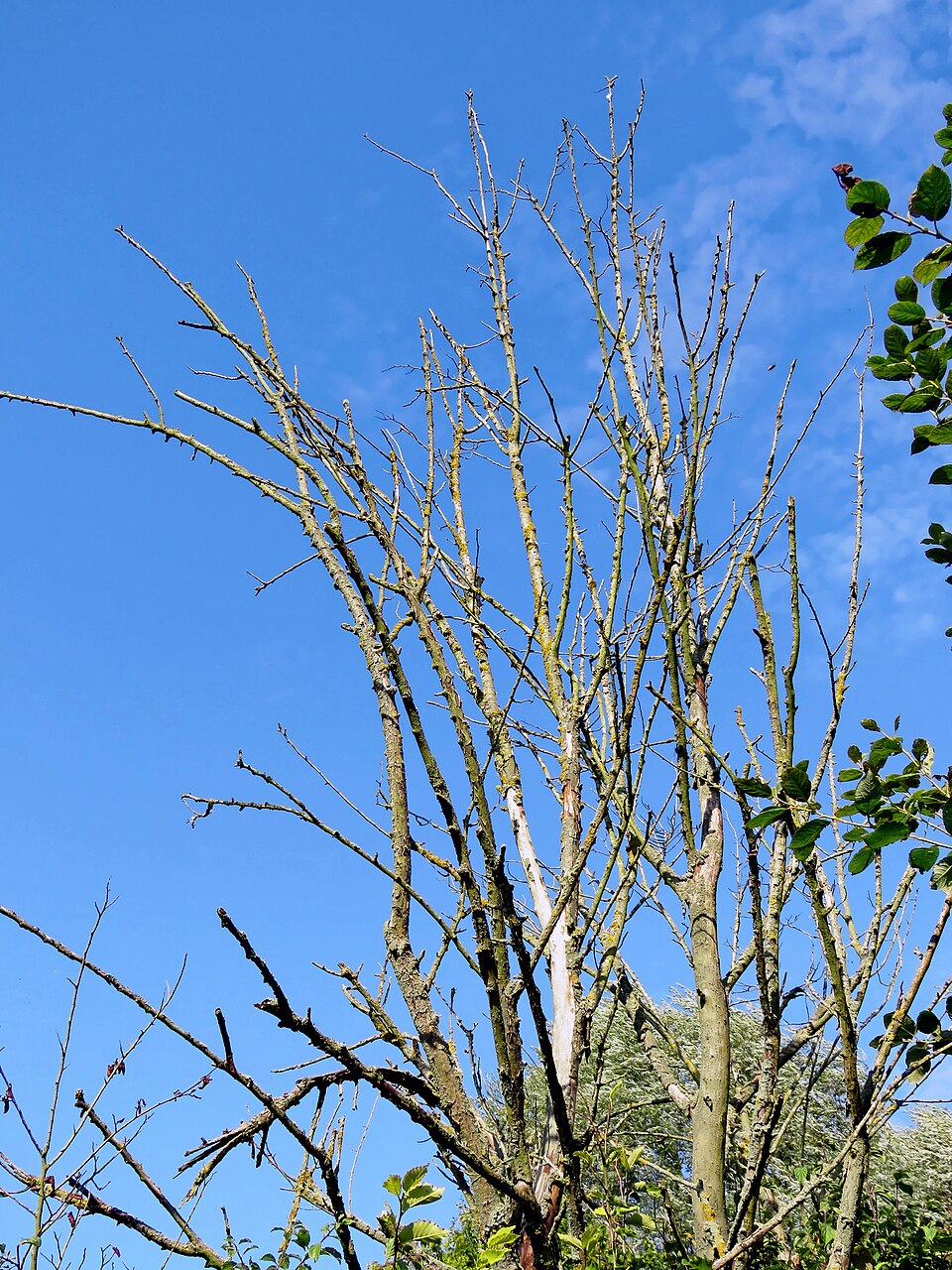
Dead wood spreading from the top downwards, or from the branch tips inwards, is a different matter. Progressive dieback points at the roots, the stem or a disease, and taking the dead wood out then treats the appearance rather than the cause. On ash it may be ash dieback. See ash dieback removal. Where deadwood is a symptom, the useful outcome of the visit is a straight opinion on the tree, not a tidier crown.
How the work is decided: the target, not the branch
Risk from a branch is the chance of it failing multiplied by what is underneath when it does. The second half is the part people leave out, and it decides the job.
What sits underneath
A dead limb over a busy footpath, a parking bay, a playground or a garden bench is a different proposition from the identical limb over a nettle patch at the back of a field. Same branch, same tree, different answer. On a managed site we walk the tree with its use in mind: where people go, where cars stand, which hours are busy.
Size, height and attachment
A dead twig falling forty feet is a nuisance. A dead limb the thickness of your leg falling forty feet isn’t. We look at diameter, the height it would fall from, whether the attachment is sound or already torn, and whether the wood is still flexible or has gone brittle.
Deadwood we remove and deadwood we leave
Standing dead wood is one of the scarcer habitats in the British landscape. It supports beetles and fungi, and the birds and bats that feed and roost in it. Stripping every dead branch out of every tree is a real loss, and on most sites it isn’t necessary.
So the approach is proportionate. Where a target sits underneath, the wood comes out. Where nothing does, dead wood can stay in the crown, or a limb can be shortened back to a safe length with the stub deliberately retained rather than removed. On a declining tree in an open position, reducing it to a standing monolith rather than felling it keeps the habitat and removes the risk at the same time. Those are decisions to make deliberately and write down, not decisions to make with a saw already running.
The occupier duty of care
If you own or manage land with trees on it, you owe a duty of care to the people who come onto it. That duty sits in the Occupiers' Liability Act 1957 for lawful visitors, with a narrower duty towards trespassers under the 1984 Act. What matters in practice is whether the risk was reasonably foreseeable and whether reasonable steps were taken.
For trees that means proportionate, recorded inspection rather than a promise that nothing will ever fall. A tree over a school entrance gets looked at more often than a tree in the middle of a field. The record matters as much as the work: an inspection you can’t evidence is hard to lean on afterwards. Managed sites usually handle this on a cycle rather than as a single visit. See commercial tree surgery and commercial tree maintenance, or tree surveys where a formal report is what you actually need.
Timing, nests and bats
Deadwood removal isn’t seasonal in the way pruning is. Dead wood can be taken out at any time of year. Two things do constrain it. Active bird nests are protected under the Wildlife and Countryside Act 1981 while in use or being built. And dead limbs, torn unions and cavities are exactly where bats roost. All bat species and their roosts are protected, so where there are signs of a roost we stop and the work goes to a licensed ecologist before it goes any further.
What drives the price
We quote per job after a site assessment. The drivers are tree height, how far the climber has to travel through the crown, the number and size of the pieces, whether wood can be dropped clear or roped and lowered over something, access for the chipper and the vehicle, waste volume, and any pedestrian or traffic controls.
What isn’t included
Deadwood removal is planned work on a tree that’s staying. A limb hanging over something now, a split stem or a storm-damaged tree is urgent and belongs with emergency tree work, and a tree already down with fallen tree removal. Crown reduction, thinning and lifting are separate pruning operations, quoted separately. See tree pruning. Taking the whole tree down is tree removal. A completion note isn’t a formal tree risk assessment or a BS5837 survey, and we’ll say so when one of those is what the situation calls for.
Qualifications and cover. NPTC qualified. LANTRA qualified. Constructionline Gold certified. £10M public liability insurance. Site-specific RAMS and a written completion note on commercial sites.
What customers ask
Common questions
Does deadwood mean my tree is dying?
Not on its own. A healthy tree sheds its own shaded lower and inner branches, so some dead wood in the lower crown of a mature oak or beech is normal. What matters is the pattern. Dead wood spreading from the top down or from the branch tips inwards suggests a problem at the roots, in the stem or from disease, and that needs assessing rather than just cutting out.
Do all the dead branches have to come out?
No, and we would rather they didn’t. Standing dead wood is scarce habitat that takes decades to form. Where something sits underneath, the wood comes out. Where nothing does, it can stay, or a limb can be shortened to a safe length and the stub retained on purpose. We explain what we’re leaving and why.
When can deadwood be removed?
Any time of year. It isn’t seasonal like pruning, and urgent wood shouldn’t wait. Two things can delay it: an active bird nest, which is protected under the Wildlife and Countryside Act 1981 while in use or being built, and signs of a bat roost in a cavity or dead limb, which stops the work until a licensed ecologist has been involved.
Is a hanging branch deadwood removal or emergency work?
If a limb is hanging over something now, treat it as urgent and call. Deadwood removal is planned work booked in a diary. Making a hazard safe today is emergency tree work, and the two are priced and scheduled differently.
How much does deadwood removal cost?
We quote per job after a site assessment. Tree height, how far the climber has to move through the crown, the number and size of pieces, whether wood can be dropped clear or must be roped and lowered, the number of trees, access for the chipper, waste volume and any pedestrian or traffic controls all affect it.
Been told a tree has dangerous branches?
Send photos of the whole tree, the branches you’re worried about and what sits underneath them. We’ll arrange an inspection and tell you what genuinely needs to come out.