Your BS5837 tree survey is back. Before tree work starts, the survey findings need to become an agreed work specification, with protection measures, permissions and access confirmed.
This guide explains how to move from the report to tree removal, pruning and site clearance without confusing a survey recommendation with permission to work.
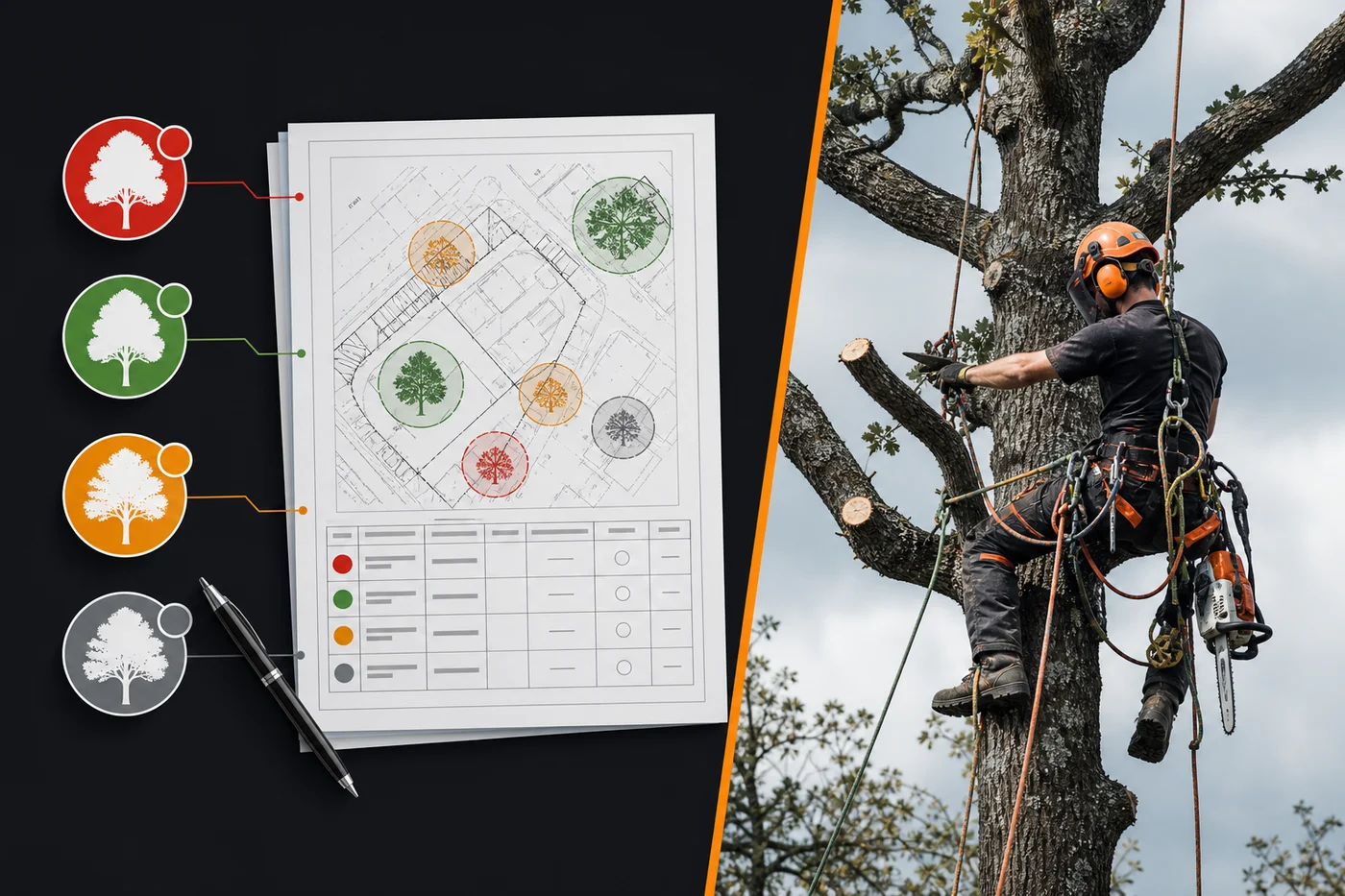
What the four categories mean for your build
The survey records each tree’s condition, quality and retention value. The category helps the design team and contractor discuss options, but it does not itself grant permission or decide the final work.
- Category U: Unsuitable for retention
- Condition makes the tree unsuitable for retention. Not a felling permission.
- Category A: High quality and value
- High quality and high value. Priority for retention and protection.
- Category B: Moderate quality and value
- Moderate quality and value. Retained where practicable.
- Category C: Low quality and value
- Lower quality and value. May be retained, pruned or proposed for removal.
The full explanation of what each category records, and what it does not authorise, is in BS5837 tree categories explained.
The survey informs the plan. The approved scheme, any planning conditions, protection measures and required consents determine the work that can proceed. Our job is to carry out the agreed specification safely and efficiently.
A realistic programme for a commercial site
Timelines vary. A small domestic plot with a few trees can be a one-day job. A two-acre commercial clearance with retained trees is a staged job rather than a single visit, and the categories tell you which trees are in the conversation at each stage.
1. Access and protection. Confirm the route in for plant and timber, then install what the approved tree protection plan requires: fencing around root protection areas, ground protection where machinery crosses. Retained Category A and B trees are normally where that starts, because they carry the highest retention value, but a retained Category C tree needs its root protection area respected just as much. It all goes in before anything is cut near a tree that is staying.
2. Consents and paperwork. A TPO application or a section 211 notice in a conservation area has to be resolved before the affected work starts, whatever category the tree is in. A conservation area notice carries a six-week council response window, so it belongs at the front of your programme, not the week you want the crew on site. Method statements and site inductions go in the same place.
3. The trees coming out. Category U trees are normally the first candidates, because their condition makes retention unrealistic, and Category C trees are often the ones a scheme gives up because their retention value is lower. Straight felling where there is a clear drop zone. Sectional dismantling with rigging where buildings, boundaries, services or roads are close. This is normally the longest single phase.
4. Work to the retained trees. Approved pruning, crown work and deadwood removal on the trees the scheme keeps, which is mostly Category A and B, plus any Category C that stays. This often runs alongside phase three on another part of the site.
5. Stump work and arisings. Stumps from the trees that came out, ground to the agreed depth where it is in scope, then timber, chip and waste handled as the written quote states, leaving the agreed finish for the groundworks crew.
What each category normally means for the programme
| Category | What it normally means for the programme |
|---|
| U | Usually a candidate for removal, because condition makes retention unrealistic. The removal still has to be in the agreed specification, with consent or notice where the tree is protected. |
| A | Retained and protected, with the tree protection plan built around it. Pruning only where the specification asks for it. |
| B | Retained where practicable. Work where the layout or the tree’s own condition requires it, such as crown lifting over a new access. |
| C | Often the trees a scheme gives up to make the layout work, because the retention value is lower. Retention, pruning and removal are all possible; the design and the specification decide. |
What a category does not do is set the order. U is a condition finding, not a work instruction, and C is not automatically for the chop. Consents, ecology constraints and the approved specification still decide what happens and when.
What moves those phases is what actually sets the programme, and the delays that catch people out are covered below.
What causes delays
Several practical factors affect how long the work takes.
Access is the biggest one. Can we get a tracked chipper and a MEWP through the gate? If not, we have to haul waste by hand or with smaller kit. This adds time and cost. We always visit the site to price the job because drawings don’t show you access constraints.
Trees close to buildings require care. Buildings and limited drop space may require sectional dismantling rather than felling in one piece. Controlled lowering adds time to the job.
Consents that arrive late. Protected-tree work cannot start until the consent is in place or the notice period has run. A report or application that lands after your programme is fixed is the most common reason the tree work ends up on the critical path.
Ground conditions matter. Wet or soft ground can restrict machinery and waste handling. The programme needs to allow for the actual ground conditions and protection requirements.
Ecology pauses are non-negotiable. A nest in use or being built stops work on that tree until the birds have finished, whenever that falls. Nesting is most likely between March and August, so a spring start carries more risk to the programme. A bat roost needs a licensed surveyor.
The equipment you’ll see
The kit depends on the job. A small garden removal might need a chainsaw, a chipper, and two of us.
A commercial clearance brings more. Tracked chippers for rough ground. MEWPs for high canopy work. Winches and rigging for dismantling near structures. Stump grinding where it is included in the agreed work.
We bring what the job needs. You don’t have to arrange any of it, but knowing what is coming helps you plan around it.
How we work from your survey
The survey and the tree work are separate commissions. Send an existing consultant’s report if you have one; it gives us the starting point for a work quote.
If you still need a report, see BS5837 tree surveys for planning. We confirm the survey provider and deliverables before appointment. Removal, pruning and clearance are quoted separately against the agreed specification.
The site clearance programme must account for retained trees, planning conditions and the scope agreed with the project team.
What we need to quote the job
When you’re ready, send us the full BS5837 report, including the tree schedule and site plan. If there are Tree Preservation Orders or Conservation Area constraints, include that documentation.
We also need site access details. Tell us about gate sizes, weight limits, overhead cables, and neighbouring buildings. Finally, give us your construction programme. We need to know when the groundworks crew arrives so we can schedule our work first.
We agree a site visit and provide a written quote for the specified work. Tell us your target start date so we can check availability and any outstanding constraints.
See also: Site clearance for construction, the practical sequence after the survey work is done. And what site managers need to know about commercial tree surgery. For the service route, see commercial site clearance and commercial tree surgery.