Foundations can’t go in until the trees in the way are out. Tree and vegetation clearance is usually the first physical work on a construction programme, so anything that delays it delays everything after it. It also has to fit the approved layout and protect the trees that are staying.
What site clearance actually means
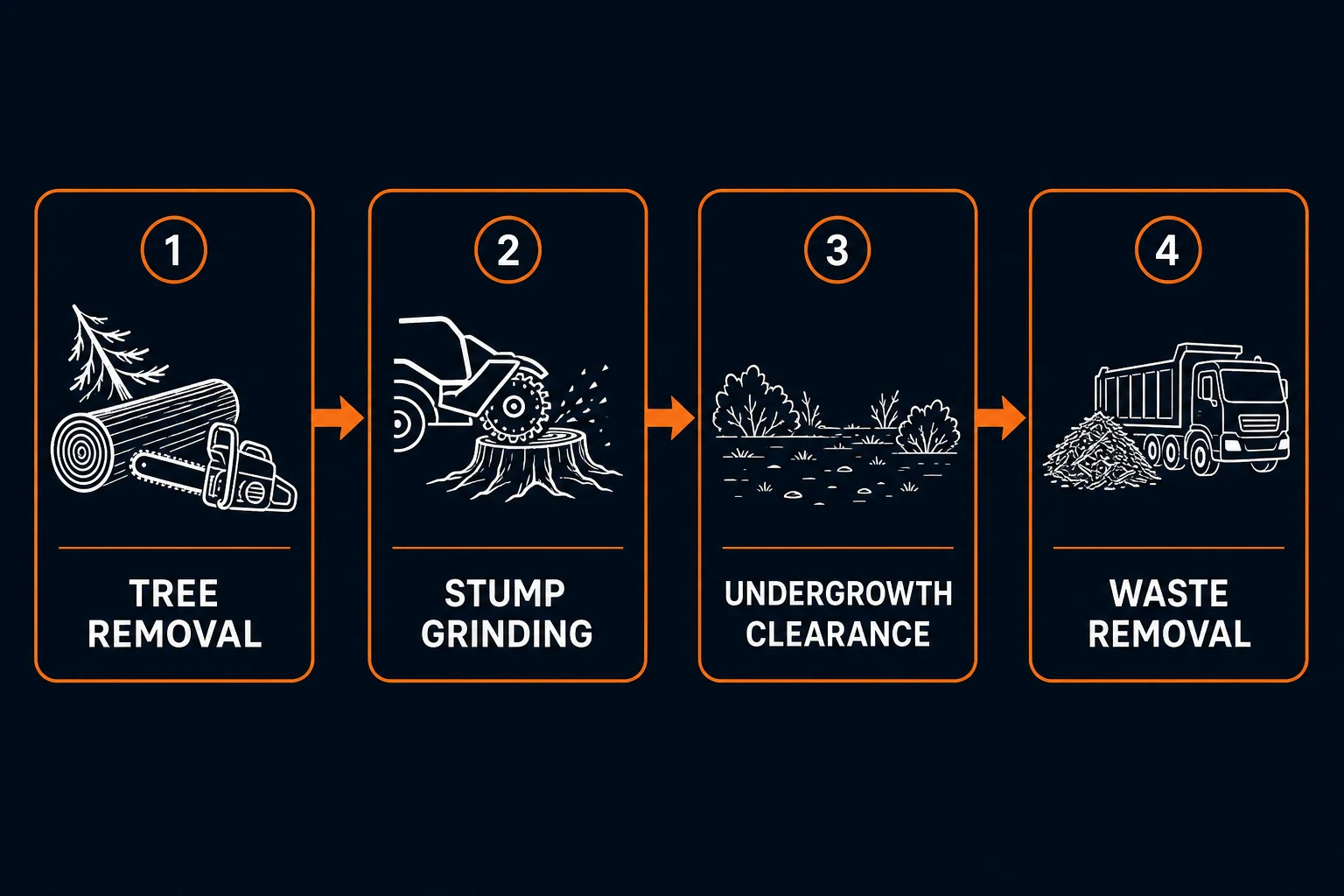
It isn’t one job. It’s a sequence of jobs, each dependent on the last.
First, we carry out the tree work included in the agreed clearance specification. That may include approved removals, pruning or sectional dismantling, and it may involve retained trees of any category where the specification requires protection or work. The survey category alone does not set the order or authorise felling.
Next come the stumps. Every felled tree leaves one behind. Stumps interfere with foundation trenches, access routes, and drainage runs. We grind the stumps to the depth agreed for the next stage, so the excavators aren’t caught out by what’s left.
We clear the agreed scrub, brambles, hedges and self-seeded growth. Cutting vegetation does not remove every root or prepare a finished surface for building.
The quote states what happens to branches, timber and stump grindings. Confirm the required handover with the next contractor; excavation, root removal and levelling may need separate groundworks.
Those are common parts of a clearance job, but the order depends on the approved scheme, access, protection, ecology, services and the work specification.
What affects the programme
Site size is the obvious factor. A half-acre plot clears faster than a five-acre one. The variables that actually cause delays are less obvious.
Access is the big one. Can we get a tracked chipper and a truck to the trees? If not, everything gets carried out by hand. The carrying distance and waste volume affect how long the job takes.
What is growing on it. Dense brambles need a different method from a mature oak that must be dismantled beside a building. The vegetation mix defines the plant and the team we send.
What is underneath. Underground services change the entire approach. Gas mains, water pipes, electric cables. Before we cut anything near known service lines, we need to see the plans. Close to services, it’s often manual work instead of machinery. Slower and more costly, but non-negotiable.
Protected species. A nest in use or being built stops work on that tree, whatever the month. Nesting is most likely between March and August, so a spring start carries more programme risk. Bats require a licensed surveyor's report. Great crested newts, badgers, reptiles. Any of them can pause the job for weeks while surveys are done or licences are secured. Your ecology report tells us which constraints apply and when.
Weather. Wet ground can stop tracked machinery from accessing the site. Frozen ground makes stump grinding harder and slower. We plan for winter contingencies, but the programme always needs more float.
Domestic versus commercial clearance
A domestic job might be a single garden with a few trees and an overgrown hedge. One truck, two men, done in a morning.
Commercial site clearance involves more. Here is what changes.
Insurance requirements. Insurance requirements come from the client’s contract, not a universal domestic or commercial threshold. We carry £10 million public liability cover; send any additional requirements before booking.
Paperwork. Every commercial job needs a site-specific risk assessment and method statement (RAMS) before we mobilise. The RAMS document covers access routes, plant positioning, overhead cables, underground services, neighbouring properties, traffic management, and waste disposal. It’s written for your site, not a generic template.
Traffic management. If the site fronts onto or adjoins a live road, you may need Chapter 8 compliant traffic management. Lane closures, banksmen, temporary signage. This has a lead time and a cost. We can coordinate it, but the programme needs to account for it.
Waste handling. Domestic green waste goes in a truck. Commercial waste requires a waste transfer note. Contaminated or treated timber goes to a different facility than clean green waste. We manage the routing and the documentation as set out in the written scope, and you should know the paperwork trail exists for your records.
What we need before we arrive
Scale site plans. Drawings showing boundaries, existing structures, service locations, and the specific areas marked for clearance.
Service drawings. Gas, water, electric, fibre. Every underground line on site. If plans are missing or incomplete, tell us before work starts. Services must be located and a safe method agreed before grinding or excavation in the affected area.
Ecology reports. Send us your bat survey, great crested newt survey, or breeding bird survey if they exist. They dictate what we can and can’t do, and the specific windows when we can do it.
TPO or Conservation Area documents. If any tree on site has a Tree Preservation Order or is within a Conservation Area, we need the consent paperwork before we touch it. Working on a protected tree without consent is a criminal offence. We can’t do it.
Your programme dates. When does the groundworks crew start? When do foundations need to be in? We schedule backwards from that date. The earlier we’re involved, the more likely we can secure the slot you need.
How we price the job
Every site is different. We quote from a site visit, not from drawings. A flat site with good access and a dozen small trees is priced differently to a steep slope with mature oaks next to overhead lines.
Guide prices don’t work for this trade. Too many variables. What you get is a fixed price after we’ve walked the ground. No hidden extras. The number we quote is the number you pay.
See also: After the BS5837 tree survey: what happens next, how we work from your survey report. And what site managers need to know about commercial tree surgery. For the service route, see commercial site clearance and commercial tree surgery.