
Tree Surgeon in Stockton-on-Tees
Tree removal, pruning, stump grinding and hedge work in Stockton-on-Tees and nearby areas. Site assessment and a written quote for the agreed work.
For a garden job send the postcode and photos. For a site send the location, the tree survey and schedule, access arrangements and your programme dates.
What our customers say
“I was recommended Ross to cut down and trim a large conifer hedge.”
“He came out quickly after getting in contact to assess what needed doing and provide a quote.”
“Very professional and educated me what was the best way to do the job.”
“He was quick, efficient and did a great job of clearing away.”
“Will definitely be using again and recommending to others.”
- NPTC qualified
- LANTRA qualified
- £10M public liability insurance
- BS3998 standard
Tree surgery in Stockton-on-Tees and the Tees Valley
Tree surgery in Stockton-on-Tees and nearby areas, including removal, pruning, stump grinding and hedge work. For commercial sites, send any existing tree schedule or approved work specification so we can quote for the physical work required.
We work across the Stockton borough on two kinds of job. One is domestic: a tree too close to a house in Norton or Thornaby, a screen that has stopped being a hedge in Eaglescliffe, a stump somebody else left in Ingleby Barwick. The other is site work, where trees have to be removed, protected or pruned before or during a build.
For garden work, send your postcode and photos of the tree and access if you can take them safely. For a site, include the specification, tree schedule or planning condition if you have one and your preferred dates. We’ll arrange an assessment and provide a written quote.
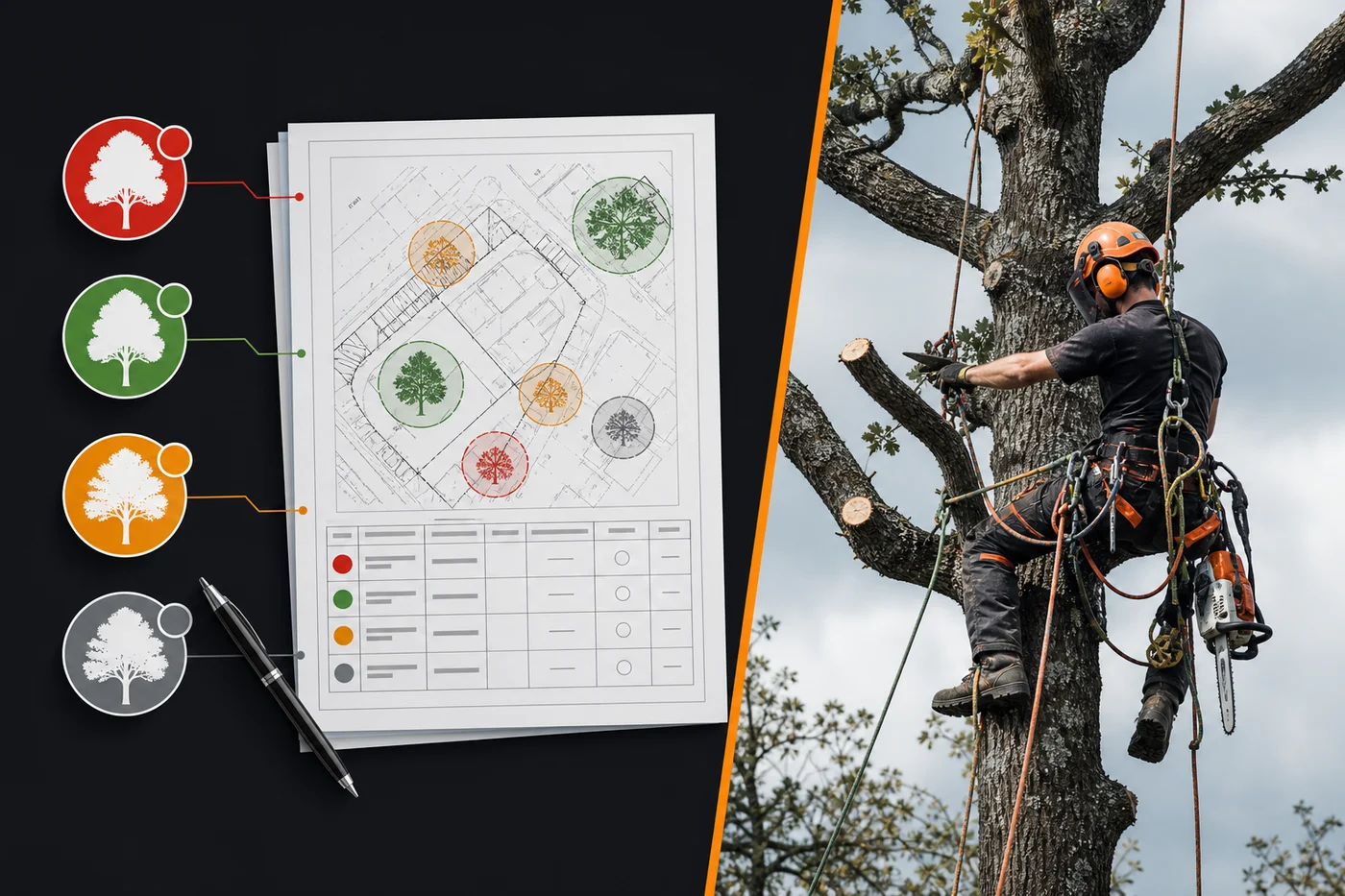
Work we carry out across the borough
- Tree removal and dismantling
- Felling where there’s a drop zone, sectional dismantling where buildings, walls, roads or services are close. See tree removal.
- Pruning and deadwood
- Crown reduction, thinning, lifting for clearance and deadwood removal, on garden trees and on retained trees inside a scheme.
- Work from a specification
- Removals, pruning and protection work specified by a tree schedule, a planning condition or another professional's report. If you still need a survey or report prepared, that is arranged separately through the appropriate provider. Physical tree work is quoted from the specification.
- Stumps, hedges and clearance
- Stump grinding, hedge reductions and site or boundary clearance where it’s in the scope. See stump grinding and site clearance.
Tree work on development sites in the Tees Valley
Stockton is where most of our construction-related tree work comes from, because it’s where the development is: the edges of Ingleby Barwick, Wynyard, the Billingham estates and the town centre sites. There’s no blanket rule that every application needs a tree report. Where trees on or next to a site could be affected by what is proposed, the planning authority will normally want the tree information prepared to BS 5837:2012, the standard covering trees in relation to design, demolition and construction, and on many local validation lists it’s a requirement rather than a suggestion.
What the survey produces, and why the categories matter
Every tree is recorded and graded: category U for trees that should go regardless of the development, then A, B and C in descending order of retention value. That grading isn’t paperwork, it’s a design constraint. A category A tree with a large protected root area can move a house position or a driveway. A category U tree on a boundary is coming out whatever the layout does. The breakdown is in our note on BS5837 tree categories, and what happens after the survey covers the order of work on site.
Root protection areas and what actually gets built
The root protection area is calculated from stem diameter, not from where the canopy happens to end. For a single-stemmed tree it’s an area equivalent to a circle with a radius of twelve times the stem diameter, capped for the largest trees, and it can be reshaped to suit site conditions but not simply made smaller because it’s inconvenient. That figure decides where barriers go, where plant may track, where ground protection is needed and whether a drive or path over roots has to be built as a no-dig construction. It’s worth settling early, because tree protection is usually a pre-commencement condition and an officer can see from the gate whether the fencing is up.
If a condition is already attached to your permission
Send us the decision notice and the condition wording with the survey and the plans. Most conditions ask for a method statement and a tree protection plan to be approved before anything starts, and for the protection to remain for the duration of the works. We would rather read the condition and price against it than quote off a drawing and find later that the sequence was fixed all along.
Garden and grounds work across the borough
Field trees left standing inside newer estates
Ingleby Barwick and the newer edges of Thornaby and Norton were built out across farmland from the 1980s onwards, and where a hedgerow oak or ash was retained it now stands in somebody's garden or on a strip of open ground with houses on three sides. An open-grown field tree doesn’t behave like a woodland tree: heavy low limbs, wide spread, and a crown that never had to compete for light. It’s usually worth keeping, but its clearances need managing deliberately rather than cutting the tree back to a fence line. See crown lifting.
Yarm, Norton and the older tree stock
Yarm and the Norton green area hold the borough's oldest amenity trees: mature lime, beech, sycamore and horse chestnut on greens, verges and behind long walled gardens. Both have conservation-area designation over part of their extent, so the consent route has to be settled before anything is cut. The physical work differs too, with bigger sections, tighter drop zones, walls and older frontages underneath, and often a footway to control for a morning.
For garden and street tree work in Yarm itself, including the walled gardens and the riverside, see tree surgeon in Yarm. Where the job is site work or a planning condition, send the approved specification with the enquiry and we quote against it.
The Tees above and below the barrage
The barrage at Stockton holds the reach upstream of it at a steady level while below it the river is still tidal, and that changes riverside work. On the non-tidal reach up towards Yarm the water level and the bank are predictable, so willow and alder can be reduced on a cycle. Downstream, tide and bank movement are part of the assessment, and getting timber off a soft foreshore is frequently the constraint rather than the cutting.
Protected trees: Stockton-on-Tees Borough Council
Stockton-on-Tees Borough Council is the unitary authority and the planning authority for the whole borough, including Yarm, Kirklevington and Hilton, which people often still think of as North Yorkshire. TPO consent applications and section 211 conservation-area notices go to Stockton, not to Durham County Council or North Yorkshire Council. A section 211 notice carries a six-week period before work can begin; a TPO tree needs a consent application, and a protected tree isn’t untouchable, it just has a route. On any job, garden or site, the Wildlife and Countryside Act 1981 makes it an offence to damage or destroy a bird nest while it is in use or being built, which is why a nesting check sits in front of clearance work as well as pruning.
What drives the price
We quote per job or per site after an assessment, never per tree from a plan. On a garden job it’s size, species, condition, drop zone, gate and access width, how much is lowered on ropes, waste volume and whether a stump follows. On a site it is more often programme and constraint: barrier and ground-protection quantities, whether plant can reach the trees at all, permitted working hours, traffic and pedestrian management, waste routes, how much has to be sequenced around other trades, and the records the condition requires. Those are the things that move a site price, not the number of stems.
What isn’t included
Demolition, groundworks, contaminated-material handling, ecology surveys and bat licensing aren’t included, and nor is protected-tree work before consent or anything outside the agreed scope. Stump grinding is priced separately unless it’s written in. Storm response goes through emergency tree work. We don’t treat Japanese knotweed; we can identify it and clear around it, with treatment referred to a licensed specialist.
Areas we cover, and what our evidence is
Stockton, Norton, Billingham, Thornaby, Yarm, Eaglescliffe, Egglescliffe, Ingleby Barwick, Preston-on-Tees, Long Newton, Wolviston, Thorpe Thewles, Bishopton, Stillington, Redmarshall, Carlton, Wynyard, Kirklevington and Hilton, with Darlington on the other side of the Tees: see tree surgery in Darlington.
Our North East tree removal case study shows how one homeowner weighed up pruning and removal. For development work, send your site requirements so we can confirm the documentation needed before appointment.
Commercial cover. NPTC and LANTRA qualified. Constructionline Gold certified. £10M public liability insurance. Site-specific RAMS and written completion reporting.
What customers ask
Common questions
Which council handles a protected tree in Stockton or Yarm?
Stockton-on-Tees Borough Council. It is a unitary authority, so TPO consent applications and section 211 conservation-area notices for the whole borough go there, including Yarm, Kirklevington and Hilton. A section 211 notice runs for six weeks before work can start; a TPO tree needs a consent application.
Do I need a BS5837 tree survey for my planning application?
Not automatically. It’s needed where trees on or next to the site could be affected by the proposal, and on many local validation lists it’s a stated requirement in those circumstances. If you’re unsure, ask the case officer or send us the site plan and we’ll tell you what we think is required.
Can the root protection area be reshaped to fit my layout?
Reshaped, sometimes. Reduced, no. The area is calculated from stem diameter, and while its shape can be adjusted for site conditions and rooting patterns, the protected area itself has to be maintained. Where a surface has to cross it, the usual answer is a no-dig construction rather than excavation.
Can you carry out work from a survey somebody else produced?
Yes. Send the full report with the tree schedule and plan, the tree protection plan, any TPO or conservation-area documentation, the condition wording and your programme dates. We price against the specification as written and confirm the sequence with your site contact before starting.
Do you do ordinary garden tree work in Stockton, or only development sites?
Both. Removals, pruning, stump grinding and hedge work for households and landlords across Stockton, Norton, Billingham, Thornaby, Yarm, Eaglescliffe and Ingleby Barwick, quoted after a site visit in the same way as a commercial job.
Tree work or a site in Stockton-on-Tees?
For a garden job send the postcode and photos. For a site send the location, the tree survey and schedule, access arrangements and your programme dates.