
Key points
What a hedge reduction actually involves
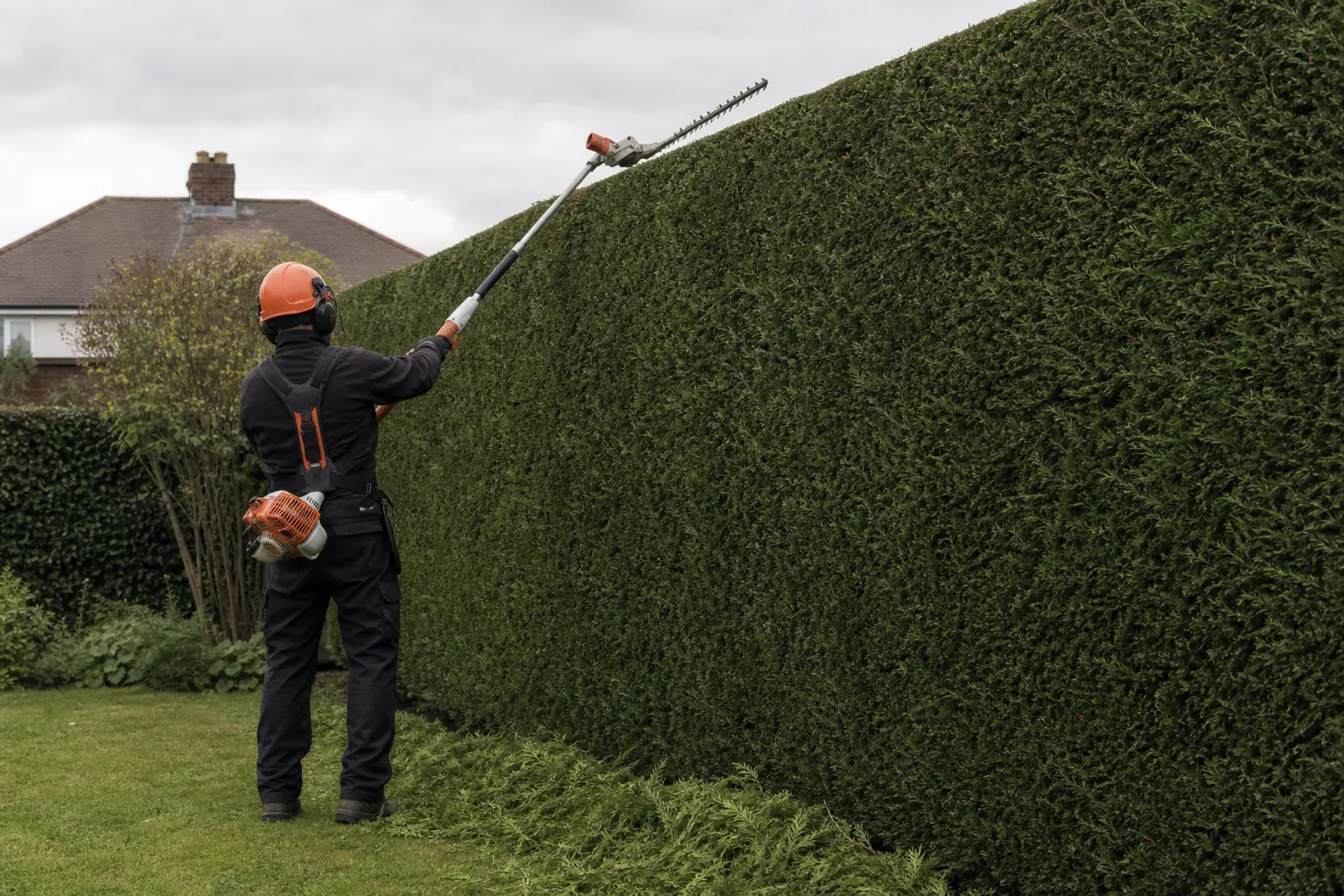
A hedge reduction isn’t a trim. A trim takes the season's new growth off a hedge that’s already the size you want. A reduction takes a hedge that has outgrown its space and brings the height, the width or both back to something you can maintain. Different cuts, different kit, different result.
Most of the hedges we get called to are reductions being described as trims: a beech boundary at four metres that was meant to be two, or a leylandii run that has taken a metre off the garden. We’ll tell you which of the two jobs it is before anyone talks about money. Routine maintenance sits on our hedge care page.
Height, width, or both
Height reduction is the more forgiving of the two: you’re cutting into wood with green growth around it, and the top of a hedge recovers fastest. Width is where hedges get ruined, because taking 300mm off a face usually means cutting through the green shell into bare brown wood. On a conifer that’s permanent. On beech, hornbeam, privet, hawthorn, holly and yew there’s normally a route back. We tell you which it is at the assessment, not after the cut.
Why the taper is the part people get wrong
A hedge should be narrower at the top than at the base. That taper, the batter, is roughly 5cm of setback per metre of height, and it’s there so daylight reaches the bottom leaves. A hedge cut with dead vertical sides shades its own base. Within a few years the lower half thins and then goes bare, and you have a green wall standing on legs and a boundary you can see through. It’s why a bare-based hedge can’t be fixed by cutting it again: the base has to be regrown, and that takes seasons.
What a professional hedge cut includes
- An assessment before a price
- Species, height, run length, density, condition of the base, access width, and what is on the other side. That decides whether the hedge is trimmed, reduced, or staged.
- A nest check on the day
- Every cut, every month of the year. If there’s an active nest, that section stops and we come back for it. See cutting a hedge with nesting birds.
- A stated target, not a tidy-up
- A finished height and width in metres, the shape and the taper, agreed before we start.
- Both faces, the top and the boundary line
- Both faces where there’s lawful access, the top, and the sides cut back to your line rather than over it.
- The waste off site
- Cuttings chipped or bagged, taken away, ground raked off. A hedge produces more volume than anyone expects, and the quote should say where it goes.
Durham work is covered on our hedge trimming in Durham page.
Overgrown hedges and reductions staged over more than one season
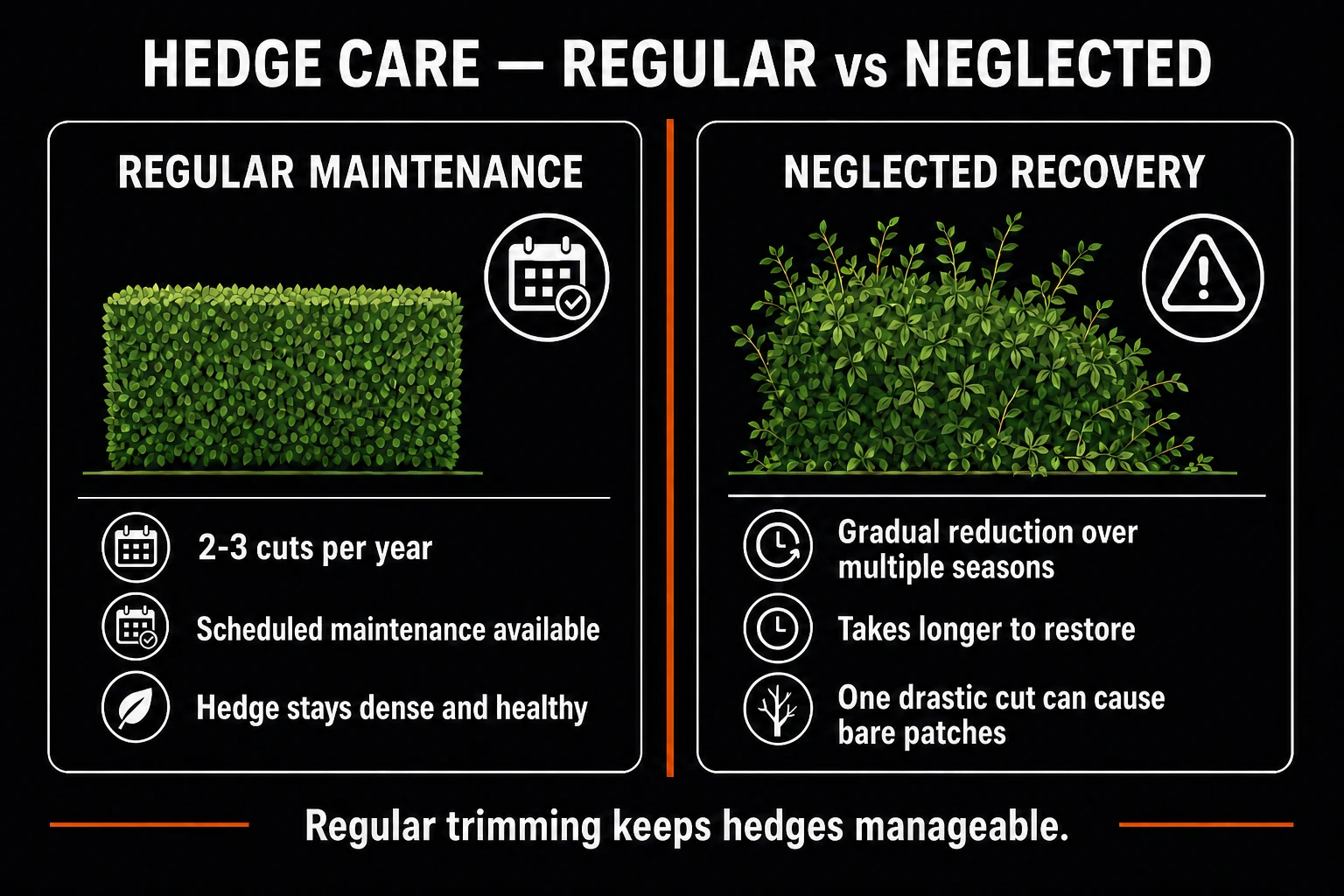
An overgrown hedge isn’t always a one-visit job, and anyone who says it is hasn’t looked at the base. What decides it is how much green foliage the hedge is left with afterwards.
How a staged reduction is sequenced
On a broadleaf hedge well past its intended size the usual sequence is the height first, then one face, then the other face a season or two later. Between stages the hedge breaks out into the cut wood and puts a new green skin on the reduced side. Only when that side has recovered do we touch the other. That means two or three visits across seasons, and the hedge looks worse before it looks better. We say so at the quote stage.
Hedges that won’t come back from old wood
Leylandii, most cypress, spruce and pine don’t shoot from bare brown wood. Whatever green shell they have is all they will ever have, which is why so many leylandii boundaries end up as flat brown walls after one enthusiastic cut. Where a conifer run has already been cut past recovery on the side that matters, removal and replanting becomes the honest answer instead of reduction: see conifer removal for a single run of leylandii or cypress, and hedge removal where a whole boundary has gone past the point where cutting brings it back. Yew is the exception among evergreens and takes a hard reduction better than almost anything else in a British garden.
What a hard cut costs you afterwards
A hedge cut too hard responds the way any woody plant does when it loses a large share of its crown at once. It pushes out a mass of fast, weak, vertical shoots around the cuts, and they grow quicker than the growth that was removed. A hacked hedge needs cutting more often afterwards, not less. The other cost is shape: once a face has gone brown or the base has gone bare, no amount of cutting brings it back inside a season. It’s the same principle that separates a proper crown reduction from topping a tree.
How hedge work is priced, and in what unit
We quote per job after a site assessment, and there are no figures on this page: a length and a height on their own don’t price a hedge. What is worth explaining is the unit, because the unit is where quotes stop being comparable.
Per linear metre isn’t per square metre
Most hedge work is measured in linear metres: walk the run with a tape, and that length is the number. Height sits on top as a band, because 20 metres of three-metre hedge is a very different job from 20 metres of knee-high box. A per-square-metre rate measures something else, the area of the cut face, and the two aren’t interchangeable. Plenty of published price guides use the terms as though they mean the same thing, which is how homeowners end up comparing quotes that never measured the same hedge. Ask each firm three things: the unit, whether it covers one face or both, and whether the top is in.
What actually moves the number
- Height and how we reach it
- Off the ground with a long-reach cutter, off a platform, or climbed. Work at height is slower and needs more setup.
- Depth of cut
- Skimming a season of growth isn’t the same work as cutting into thick wood, which means saw work and far more volume on the floor.
- Density, species and neglect
- Ivy, brambles, self-seeded ash or sycamore through the line, and thick old stems, all slow a run down.
- Access and the route for waste
- A hedge we can park alongside prices differently from one behind a narrow gate with everything barrowed out.
- What is on the other side
- A footpath, a road, a greenhouse, a neighbour's borders or a poor fence change the protection and the pace.
Frequency is the cost driver you control
The cheapest hedge to look after is one that never becomes a reduction. Cut on a sensible cycle for its species, it stays inside the shell it has and takes a fraction of the time. Left for ten years it becomes staged work, saw work and a lot of tipping.
When a garden hedge can lawfully be cut
1 March to 31 August is an agricultural rule
The closed period from 1 March to 31 August, and the wider hedgerow management rules on GOV.UK, apply to hedgerows on agricultural land. They’re obligations on the land manager farming that ground. A hedge inside the boundary of a house isn’t covered, and no date in that range is a legal bar to cutting your own garden hedge. This is the point the popular hedge articles get wrong, and it costs homeowners half a year of waiting.
Nests, not dates
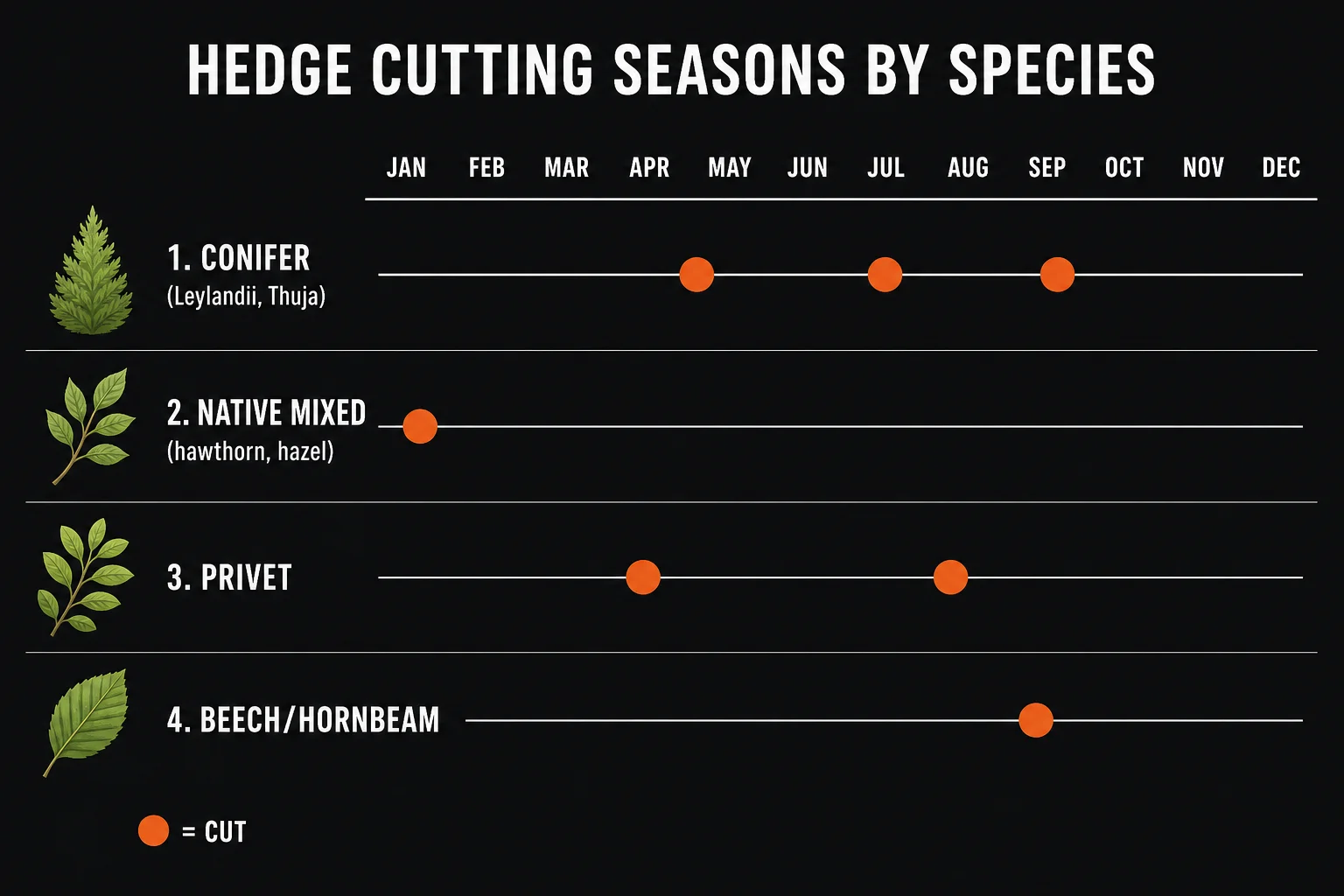
The law that applies to a garden hedge is the Wildlife and Countryside Act 1981, and it applies every day of the year: it is an offence to damage or destroy a bird's nest while that nest is in use or being built. So a garden hedge can lawfully be cut at any time of year provided there’s no active nest in it, and equally a hedge with a late nest in October can’t be cut. It’s a condition, not a season. September to February is only the quietest window because you’re least likely to find anything. The full position is in our domestic hedge cutting rules.
What a height complaint can and can’t do
If the hedge is a neighbour's and too tall, the High Hedges provisions in Part 8 of the Anti-social Behaviour Act 2003 apply in England and Wales, to a line of two or more mostly evergreen trees or shrubs over two metres acting as a barrier to light or access. Two limits matter before anyone starts a complaint: a remedial notice cannot require the hedge to be reduced below two metres, and it cannot require the hedge to be removed. Councils set their own fee and expect to see that you tried to resolve it directly first.
What to send us for a hedge quote
Run length in metres, current height, target height, species if you know it, access width, and photos along the line and at the base. Send those details and we’ll come and look at it.
Qualifications and cover. NPTC and LANTRA qualified. Constructionline Gold certified. £10M public liability insurance. Nest checks before every cut and a written scope before work begins.
Common questions
- What is the difference between a hedge trim and a hedge reduction?
- A trim removes the season of new growth from a hedge that’s already the right size. A reduction brings an oversized hedge back in height, width or both, which means cutting into older wood. A reduction takes longer, produces far more waste, and needs a check on whether the species will regrow from the wood being cut.
- Is hedge cutting priced per metre or per square metre?
- Hedge work is normally measured in linear metres of run, with height handled as a band on top of that. Per square metre measures the area of the cut face instead, and the two aren’t interchangeable. When comparing quotes, ask for the unit, whether it covers one face or both, and whether the top is included.
- Can I cut my garden hedge in June?
- Yes, provided there’s no active nest in it. The 1 March to 31 August closed period applies to hedgerows on agricultural land, not to a hedge in a domestic garden. The Wildlife and Countryside Act 1981 is the law that covers your garden hedge, and it applies all year: check for nests, then cut.
- How far back can an overgrown hedge be cut in one go?
- It depends on how much green foliage the hedge is left with. A broadleaf hedge such as beech, hornbeam, privet or hawthorn can usually be reduced in height first and then have one face done, with the second face left for a later season. Leylandii and most conifers won’t reshoot from bare brown wood at all, so the cut has to stay inside the green.
- Can the council make me take my hedge down?
- No. Under the High Hedges provisions in Part 8 of the Anti-social Behaviour Act 2003, in England and Wales, a remedial notice cannot require a hedge to be reduced below two metres and cannot require the hedge to be removed. It can require a reduction and ongoing maintenance above that height.
Got a tree that needs work?
We review the situation. We give you a fixed quote. No hidden costs. What we quote, you pay.