
Tree Surgery for Industrial Estates
Tree and vegetation work for industrial estates in County Durham and North Yorkshire. HGV swept paths, fence lines, overhead services and yard drainage.
Send the site plan or a marked aerial view, the largest vehicle using the estate, your shift pattern and any overhead lines. We’ll walk it and quote in writing.
What our customers say
“I was recommended Ross to cut down and trim a large conifer hedge.”
“He came out quickly after getting in contact to assess what needed doing and provide a quote.”
“Very professional and educated me what was the best way to do the job.”
“He was quick, efficient and did a great job of clearing away.”
“Will definitely be using again and recommending to others.”
- NPTC qualified
- LANTRA qualified
- £10M public liability insurance
- Constructionline Gold certified
- RAMS as standard
Tree and vegetation work on industrial estates
On an industrial estate trees are an operational item, not an amenity one. They matter when a trailer clips a limb, when a camera can’t see the fence line, or when a gully blocks and the yard floods where forklifts run. We work for estate owners, managing agents and occupiers across County Durham, North Yorkshire and the Tees Valley.
What makes a quote useful here isn’t the tree. It’s the largest vehicle using the estate, your shift pattern, where the overhead lines run, and a plan or marked aerial view. Send those and we’ll walk the site with whoever controls yard traffic.
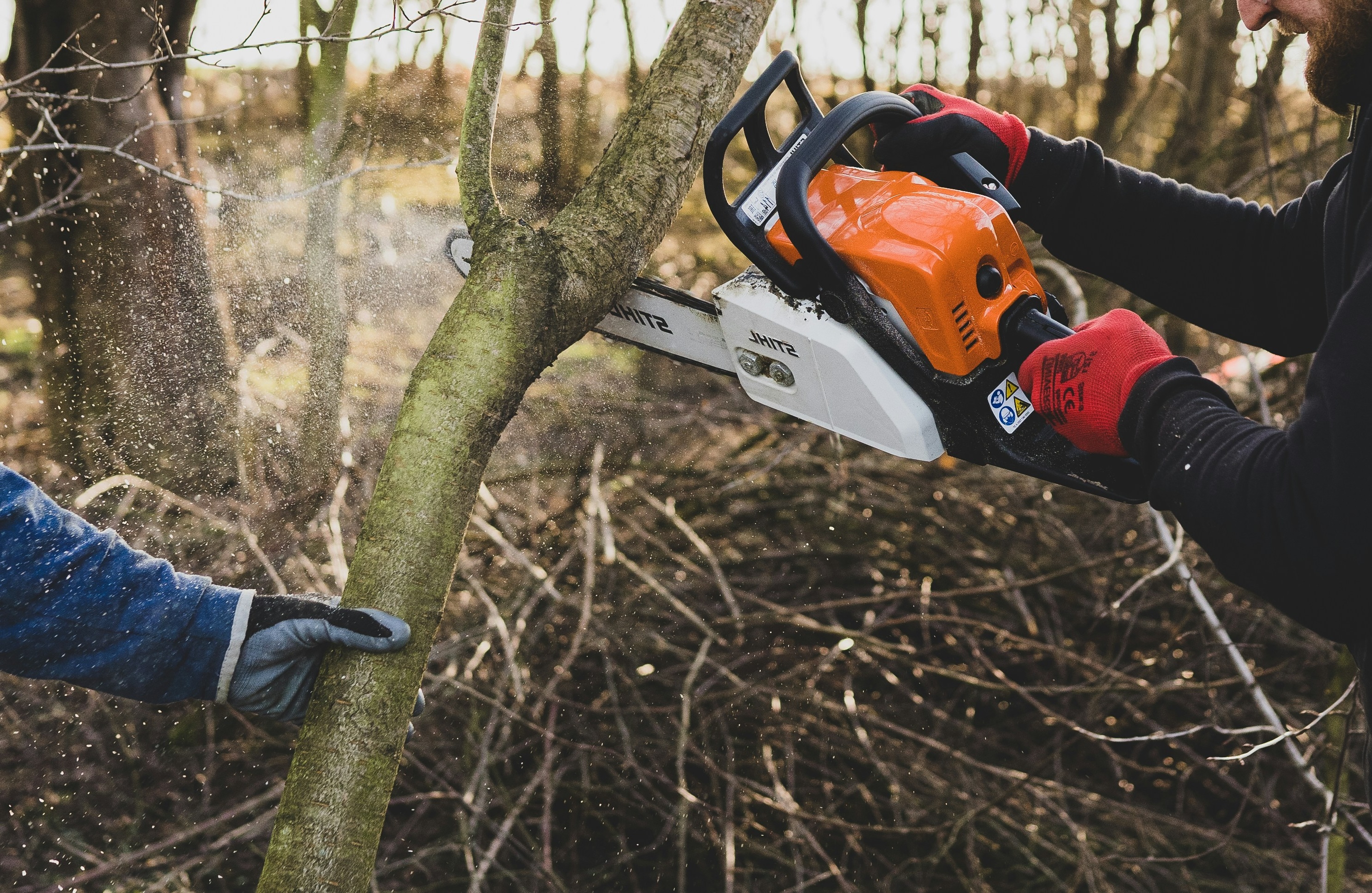
What estate tree work usually covers
- Access route and swept-path clearance
- Crown lifting over estate roads, entrances and turning areas, to the height and width the vehicles need. See crown lifting.
- Fence lines and perimeter vegetation
- Clearing both faces of a security fence so it can be seen, inspected and detected across, including ivy on panels. See vegetation management.
- Yard edges and hardstanding
- Canopy and scrub taken off yard margins, racking, container rows and walkways, so the usable area is the area you pay rates on.
- Leaf fall and drainage points
- Clearance around gullies, channels and interceptor covers before autumn.
- Removals and structural work
- Sectional dismantling where a tree is failing beside a unit, yard or line, with the drop zone off the traffic route. See tree removal.
Clearance heights are set by the vehicles, not the trees
The trailer hits what the cab misses
An articulated unit tracks a different line to its trailer. At a tight entrance the trailer cuts inside the cab and rides over the kerb and verge, which is why the struck limb is usually two or three metres back from the corner rather than at the apex. We measure the swept path with your traffic controller and clear to it, including a trailer reversing into a dock.
Tippers, skips and hiabs need height above the roof line
Headroom over an estate road isn’t the number that matters if the vehicle raises something. A tipper discharging or a skip lorry lifting a container over its cab needs clear air well above the vehicle itself, and they do it in a fixed position, usually beside the same tree every time. Tell us where those positions are and we clear a column there, which isn’t the same specification as even clearance along a road.
Visibility splays and gate lines
Many estates carry a planning condition requiring the visibility splay at the junction to be kept clear above a stated height. Self-set shrubs and low branches breach it long before anyone notices, because the sightline degrades gradually.
Perimeter fence lines and security
Vegetation that sets off your detection
Branches moving in front of a PIR or across a beam produce false activations, and those produce keyholder call-outs at three in the morning and eventually a suppressed zone. Canopy also shades lighting columns, and CCTV commissioned in February can be looking into a wall of leaves by July. So we clear to your camera positions and detector zones, not to a tidy line.
A tree beside a palisade fence is a ladder
A stem either side of the line gives a climb over anti-climb topping, and a heavy limb across it gives a bridge. Insurers and security surveys ask for a clear zone either side of the boundary for that reason. Vegetation in the line does its own damage too: ivy racking panels, roots pushing posts out of true, and brambles that make it impossible to spot a cut in the fence.
Overhead lines and buried services
Estate yards often have distribution lines crossing them and a service drop into each unit. We treat every conductor as live rather than assume it’s dead or insulated. Where work can’t keep a safe distance, the network operator arranges shrouding or a planned shutdown, and that lead time runs to weeks, so it enters the programme at quoting stage. We follow HSE guidance on avoiding danger from overhead power lines.
Below ground matters too. Estate margins carry supplies, comms ducts and drainage, so a stump needs service information or a scan before a grinder goes in. See stump grinding.
Hardstanding, drainage and slip risk
Roots under yard surfacing
Tarmac and block paving lift over roots long before the tree looks like a problem, and on a yard that lift sits under forklift and pallet-truck wheels. Removing the tree doesn’t fix the surface, and cutting major roots to save surfacing can leave a tall tree unstable beside a building.
Gullies, interceptors and autumn
A yard drains to gullies and often through an oil interceptor before discharge. Leaf litter blocks the gully, water collects in the flattest part of the yard, which is usually where vehicles load, and in a frost that becomes ice on a route pedestrians share with plant.
Working in a live yard
Yards don’t stop, so we plan around vehicle movements: exclusion zones off the traffic route, a banksman where a chipper feeds near a forklift run, and phased work so no dock is out of use longer than agreed. Where a saw runs near a fuel store, a waste yard or dry combustible storage, that’s a hot works permit before it’s a tree job. Shutdown weeks and shift changeovers are the cheapest windows on an estate, and they book up early.
Protected trees, planted screens and knotweed
Industrial estates are usually landscaped to a planning condition. The perimeter belt may carry a Tree Preservation Order, and even where it doesn’t, the original consent may require the screen to be retained, so clearing it flat isn’t an option. Where the estate sits in a conservation area, work needs a section 211 notice with a six-week period. Boundary scrub and ivy get a nest check before cutting, under the Wildlife and Countryside Act 1981. Japanese knotweed turns up on older industrial land: we identify it and can clear mechanically, but treatment goes to a licensed specialist.
What drives the price
We quote per site after a walkover. The drivers are access and what the yard forces on us, the height and position of the clearance, traffic control, whether the network operator has to be involved, waste volume, and whether the work fits normal hours or a shutdown window. A whole perimeter priced at once costs less than the same work split over three visits. For recurring clearance see commercial tree maintenance, and for the documentation set see commercial tree surgery.
What isn’t included
We don’t repair hardstanding, drainage, kerbs, fencing or lighting, and we don’t clean gutters or unit roofs. Traffic management design, road closures and specialist lifting are priced separately. Arboricultural and ecology surveys are separate: see tree surveys. Clearance ahead of construction sits under commercial site clearance.
Commercial cover. NPTC and LANTRA qualified. Constructionline Gold certified. £10M public liability insurance. Site-specific RAMS and written completion reporting.
What customers ask
Common questions
What height do you clear an estate road or yard to?
To the vehicles that use it, not to a standard figure. Tell us the largest unit on site and whether anything tips, slews or lifts, and where it does that. A raised tipper body or a skip lifted over a cab needs far more clear air than the vehicle height suggests.
Can you work without shutting the yard?
Usually yes. We phase the work, site exclusion zones off the traffic route and use a banksman where a chipper or drop zone sits near a vehicle or forklift run. Some positions do need a dock or a bay out of use for a set period, and we agree that in advance.
There’s an overhead line across our yard. Can you still work?
Only on the basis that it’s live. If the work can’t keep a safe distance, the network operator has to shroud the line or arrange a planned shutdown, which takes weeks to book. We flag it at quoting stage so it doesn’t stop the job on the day.
Roots are lifting our yard surface. Does removing the tree fix it?
It stops it getting worse. It doesn’t level the surfacing, and the stump and main roots stay unless they’re ground out. Cutting large roots to save a surface can also destabilise a tall tree beside a building, so we set out that trade-off in writing before you choose.
We have knotweed along the boundary. Can you deal with it?
Tell us about it before booking clearance. We do not offer herbicide treatment programmes or insurance-backed knotweed guarantees. Treatment and material handling need a specialist plan before surrounding vegetation is cleared.
Get your yard and access route assessed
Send the site plan or a marked aerial view, the largest vehicle using the estate, your shift pattern and any overhead lines. We’ll walk it and quote in writing.