
Tree Surgery for Care Homes
Tree work at care homes across County Durham and North Yorkshire, planned around resident routines, dementia units, fire routes and single-day completion.
Send the address, photographs of the trees and the days that suit the home. We’ll assess the site with your maintenance lead and quote in writing with RAMS.
What our customers say
“I was recommended Ross to cut down and trim a large conifer hedge.”
“He came out quickly after getting in contact to assess what needed doing and provide a quote.”
“Very professional and educated me what was the best way to do the job.”
“He was quick, efficient and did a great job of clearing away.”
“Will definitely be using again and recommending to others.”
- NPTC qualified
- LANTRA qualified
- £10M public liability insurance
- Constructionline Gold certified
- RAMS as standard
Tree surgery for care homes in County Durham and North Yorkshire
A care home is occupied every hour of every day. There’s no half term, no bank holiday shutdown and no empty weekend, so the work has to be planned around people who are at home while it happens. We work on care home grounds across County Durham, Darlington and North Yorkshire: car park and boundary trees, limbs over footpaths, hedges and screens, and storm damage.
Send the address, photos and a site layout if you have one. We’ll discuss the work with your maintenance lead and confirm access, working hours and site-specific RAMS before booking. See our commercial tree surgery page for the wider service.
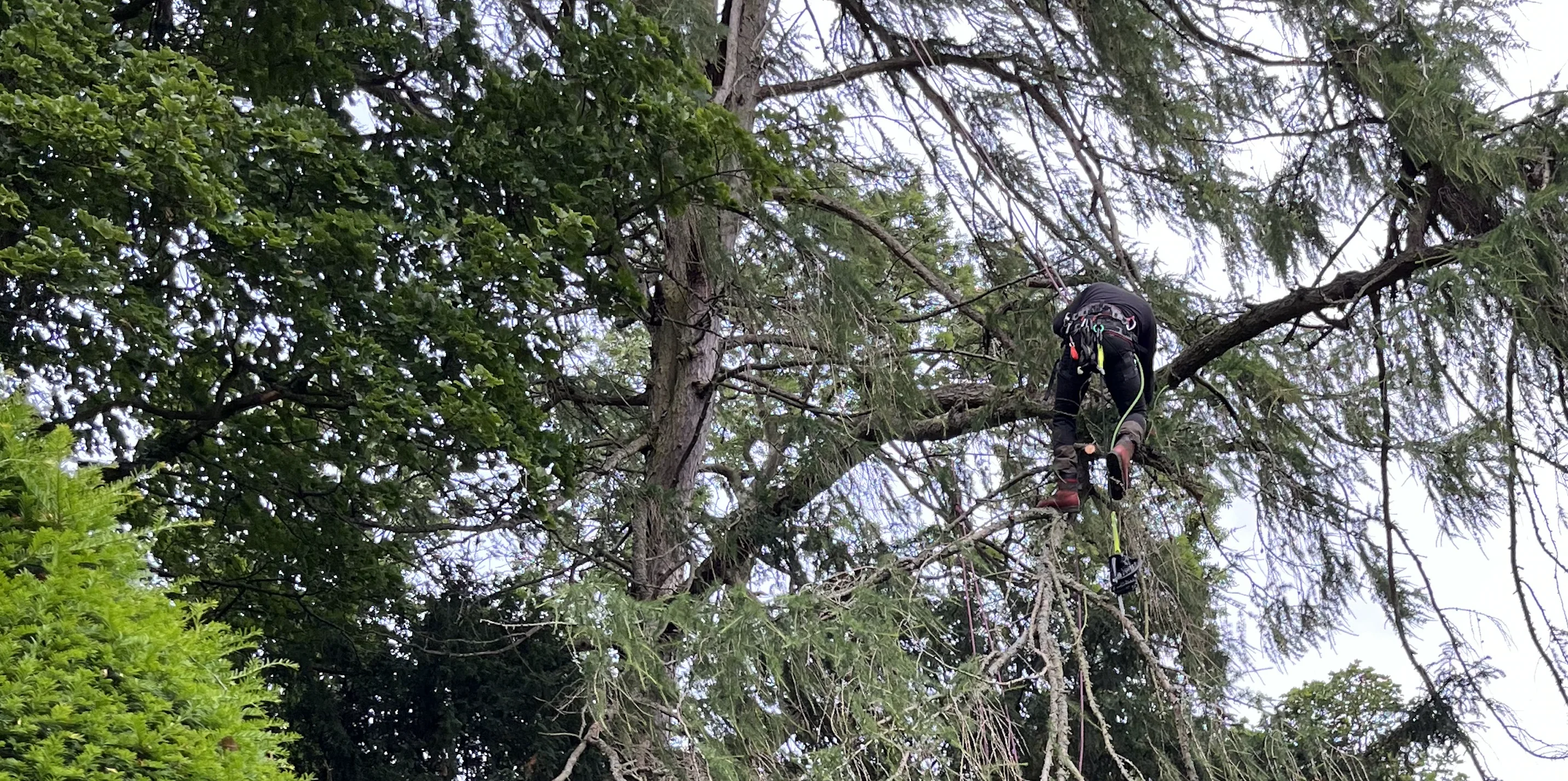
What we take on at a care home
- Car park and access trees
- Limbs over parking bays, the ambulance bay and the minibus route. Lime and sycamore drop honeydew onto cars all summer, the first complaint we usually hear.
- Footpath and window clearance
- Crown lifting for headroom over paths used with frames and wheelchairs, and pruning off bedroom and lounge windows to return daylight. See tree pruning.
- Hedges, screens and boundaries
- Trimming and staged reduction of boundary screens, including conifer hedges grown across ground floor windows. See hedge care.
- Dead, failing and storm damaged trees
- Removal or make safe where the tree stands over a building, a path or the car park. See emergency tree work and tree removal.
Why one day on site beats a cheaper three days
On most commercial sites the lowest quote wins, because disruption is close to free. A care home is the exception. Every day we’re there’s a day the garden doors stay shut, the car park loses spaces, staff field questions and the routine that keeps residents settled is broken. That cost lands on the home and never reaches an invoice.
So we price the option that finishes it: a larger crew for one day, arisings away in a tipper rather than a chipper running on site for three afternoons. It can be the higher figure on paper and still be the cheaper day for the home.
What we don’t leave overnight
If a job needs two days, nothing is left part cut and no timber or equipment stays in a garden residents use. Paths are blown and swept before we leave each day, not at the end of the job: wet leaf litter and chip dust on a smooth path is a fall risk for the people least able to absorb one.
Noise, unfamiliar activity and residents living with dementia
Saw and chipper noise carries further than people expect, and the chipper is the worst of it because the sound never stops. For a resident living with dementia, unexplained noise and unfamiliar people in a garden they know well causes real distress, and care staff are the ones who manage it.
Sequencing the loud work away from the unit
Tell us which windows belong to the dementia unit and which rooms are in use during the day. We start at the far end of the site and work back towards the building, put the chipper on the far side of the car park with the feed pointing away, and keep saw runs short.
Telling staff before the day, not on it
Staff can prepare residents for something they know is coming. We confirm the date, the arrival time, which side we start on and when the loudest part falls. If a tree a resident looks at every morning is coming down, say so beforehand: the view changing without warning is what unsettles people. We also say which windows to close, because chip dust through an open bedroom window is avoidable.
Car parks, fire routes and ambulance access
A parking space here isn’t just a parking space. The ambulance bay and its turning room stay clear the whole time we’re on site, and if the tipper or the chipper affects that, it moves. External escape routes stay open and nothing crosses them: no ropes, no hoses, no brash piles. Evacuation from a care home is slow and staff dependent, so a blocked route isn’t a paperwork problem.
Soft lawns, soakaways and hand carrying
Lawns here are soft, often with soakaways and private drainage beneath and resident furniture round the edge. Where the ground will rut we hand carry to the hard standing rather than drive on it, and price that in from the start.
The record an inspection can actually use
CQC has no rule about trees. What registration brings is a duty about premises: regulation 15 of the Health and Social Care Act 2008 (Regulated Activities) Regulations 2014 requires premises to be suitable and properly maintained, and the grounds are part of the premises. When an inspector asks how you know the outside of the building is safe, a dated record with the actions closed off is the answer that works.
Our completion report records what was inspected, what was done and when to look again. It’s a contractor record, not a formal tree survey. Where the tree stock justifies one, a tree survey and a tree maintenance programme put the site on a cycle, and our article on tree safety inspections explains the regime.
Who actually signs this off
The person who calls is often the maintenance handyman, and they can’t authorise the spend. The registered manager controls the date, site access and anything touching resident welfare. The money frequently sits with a regional or head office facilities manager, and in a group there’s a helpdesk and a purchase order number without which the invoice goes nowhere.
So the quote is written to be forwarded: named trees, the work on each, exclusions, date and duration on one page, with the insurance schedule and RAMS attached. Tell us who signs and whether a purchase order is needed, and the date won’t slip.
What we aren’t, and what isn’t included
We aren’t DBS checked. Our work is outside the building and needs no unsupervised access to residents or resident areas. If your policy requires every contractor to be DBS checked, say so at enquiry stage and rule us out before anyone wastes a visit.
A visit doesn’t include grounds maintenance, grass cutting, fencing repair, ecology surveys or arboricultural reports. Stump grinding is quoted separately where the assessment shows it’s needed. See stump grinding.
What drives the price
We quote per site after an assessment and publish no figures. What moves the number here: crew size against working days, whether arisings are chipped on site or leave in a tipper, how much is hand carried off soft ground, whether the car park is worked in sections to keep the ambulance bay open, proximity to occupied windows, protected tree consents and work outside normal hours.
Commercial cover. NPTC and LANTRA qualified. Constructionline Gold certified. £10M public liability insurance. Site-specific RAMS and written completion reporting.
What customers ask
Common questions
Can you complete the work in a single day?
Often yes, and at a care home it’s usually worth planning for. We size the crew and the waste handling to finish in one visit where the tree stock allows it. Where it can’t be done in a day, we agree which side of the building we start on and leave nothing part cut overnight.
How loud is it, and can you keep away from the dementia unit?
The chipper is the loudest and most continuous noise, so it goes away from the building with the feed pointing away. Tell us which windows belong to the unit and which rooms are in use, and we sequence the work from the far end of the site inwards with breaks between saw runs.
Are you DBS checked?
No. Our work is in the grounds and doesn’t need unsupervised access to residents or to resident areas. We sign in at reception and carry identification. If your policy requires all contractors to be DBS checked, say so at enquiry stage.
What paperwork do we get for the inspection file?
Site-specific RAMS and the insurance schedule before the visit, and a written completion report afterwards recording what was inspected, what was done and what to watch. It’s a contractor record rather than a formal tree survey, and we’ll say when a survey is the right document.
Who needs to approve the works?
The registered manager controls the date and site access. The spend often sits with a regional or head office facilities manager, and many groups need a purchase order raised first. Give us both names at enquiry stage and the quote can be written to be forwarded straight up.
Plan a care home visit
Send the address, photographs of the trees and the days that suit the home. We’ll assess the site with your maintenance lead and quote in writing with RAMS.