
Tree Surgeon in Consett
Tree surgery in Consett, Leadgate, Castleside, Blackhill, Shotley Bridge and Ebchester. Exposed high ground, wind damage and conifer belts, quoted on site.
Send the postcode, photos of the whole tree and a close photo of the ground around its base. On exposed ground the base tells us more about the tree than the crown does.
What our customers say
“I was recommended Ross to cut down and trim a large conifer hedge.”
“He came out quickly after getting in contact to assess what needed doing and provide a quote.”
“Very professional and educated me what was the best way to do the job.”
“He was quick, efficient and did a great job of clearing away.”
“Will definitely be using again and recommending to others.”
- NPTC qualified
- LANTRA qualified
- £10M public liability insurance
- BS3998 standard
Tree surgery in Consett and the Derwent valley
We carry out tree removal, pruning, conifer work, stump grinding and hedge work for properties in Consett and the villages around it. The pattern of work here is different from the lower parts of the county, and it comes down to height and exposure: Consett stands high on the western shoulder above the Derwent, and takes the prevailing south-westerly straight off the Pennines.
Send the postcode, photos of the whole tree, and a close photo of the soil and turf around the base. A site assessment then confirms condition, method, permissions and the written scope before a date is booked.
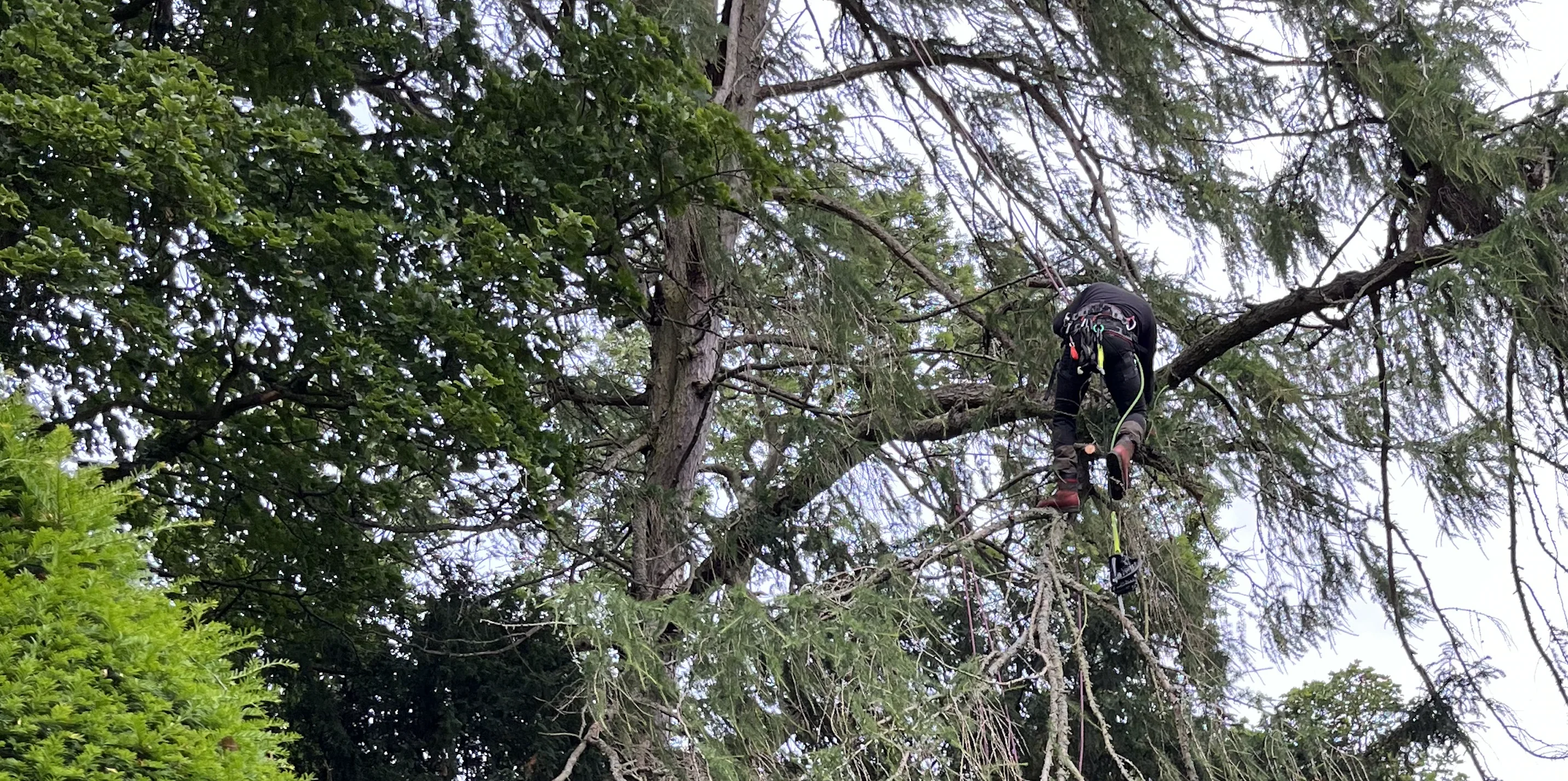
Work we carry out around Consett
- Wind-damaged and unstable trees
- Leaning trees, lifted root plates, snapped tops and hung-up limbs made safe, then cleared. See emergency tree work and fallen tree removal.
- Conifer and leylandii work
- Shelter belts and boundary rows reduced, thinned out or removed in stages. See conifer removal.
- Removal and felling
- Felling where there’s a safe drop zone, sectional dismantling where there isn’t. See tree felling and tree removal.
- Pruning, stumps and clearance
- Reduction and deadwood work, stump grinding, and clearance of self-set birch and scrub off boundaries and reclaimed ground. See tree pruning and vegetation management.
Height and exposure change what fails, and when
Root-plate failure, not branch failure
On exposed ground the tree usually doesn’t break, it moves. A tree that has been rocking in the wind lifts and cracks the soil in a ring around its base, and in a gust you can see roots working under the turf. That’s the sign that matters, and it’s the reason we ask for a photo of the base. Once a root plate has gone, taking weight out of the crown doesn’t fix it: the tree is no longer held. That’s a removal conversation, not a pruning one.
Why thinning is usually the wrong answer for wind
People ask for a crown thin to let the wind through. It rarely works. Thinning takes out interior branches and does very little to the sail area that the wind is actually pushing on, and it can leave the remaining limbs longer and less supported. Where a tree is genuinely over-exposed, the useful work is reducing the height and the outer weight, done in stages over seasons so the tree can respond. We’ll say so at the assessment even when you’ve asked for the thin. See crown thinning for what it’s genuinely for.
Shelter belts that outgrew the job
Consett has a lot of conifer planted between the 1960s and the 1980s specifically to break the wind: leylandii, Norway spruce, the odd larch. Sixty years on they’re 15 to 20 metres, shading the gardens they were planted to protect, and shallow-rooted in ground that was never deep. Leylandii won’t reshoot from brown wood, so a reduction has a hard floor below which the row will simply stay brown. That single fact decides most of these jobs: reduce and maintain on a cycle, or take it out and replant something appropriate.
Where the row is a boundary dispute as well, the High Hedges provisions in Part 8 of the Anti-social Behaviour Act 2003 apply in England and Wales. The complaint goes to Durham County Council, which sets its own fee, and the council expects to see that you tried to resolve it with the neighbour first. Two limits are worth knowing before anyone starts quoting outcomes: a remedial notice cannot require the hedge to be reduced below 2 metres, and it cannot require the hedge to be removed.
The reclamation planting on the old steelworks ground
The steelworks closed in 1980 and much of the site was cleared and reclaimed, then planted. That planting is now 30 to 40 years old and reaching the age where an even-aged block starts to matter: drawn-up stems, small crowns, and shallow rooting over made ground with slag and stone in it. On these sites the practical issues are stability of individual stems once neighbours are removed, and stump grinding running into buried fill.
A shorter working window at this height
Leaf flush is later up here and the ground stays wet longer than it does in the Derwent valley below. Frozen or saturated ground decides whether a platform or a tracked chipper can get near the tree at all, and we won’t climb in high wind. If the forecast makes a booked day unsafe we move it and tell you why, rather than turn up and charge for a morning we can’t work.
Protected trees and conservation areas: Durham County Council
Consett is Durham County Council. Tree Preservation Orders and section 211 conservation-area notices go to the county council. Several of the older Derwent-valley villages nearby sit within conservation areas, so we check the boundary against the address rather than the postcode. Conservation-area work above the qualifying size needs the notice and a six-week period; a TPO tree needs consent. The tree isn’t untouchable, but the route has to be followed. Nesting birds apply separately and all year: under the Wildlife and Countryside Act 1981 it is an offence to damage or destroy a nest in use or being built.
What drives the price of tree work in Consett
We quote per job after a site assessment. Height and stem count drive conifer work, and a row is quoted as a row rather than per tree. Beyond that: access for plant, ground conditions, how much has to be lowered on ropes, waste volume, whether arisings are chipped or taken away, buried fill under a stump, and whether the work is staged across visits. Staging costs more in total than a single visit but spreads it, and on a long belt it’s often the sensible option.
What isn’t included
Work outside the agreed trees and hedges isn’t included, and nor is protected-tree work before consent. Stump grinding is quoted separately unless written into the scope. Replanting, fencing and landscaping repairs aren’t ours. We don’t treat Japanese knotweed; we can identify it and clear vegetation around it, and treatment goes to a licensed specialist. Traffic management on an adopted road is priced separately.
We cover Blackhill, Leadgate, Delves Lane, Castleside, Moorside, Iveston, Dipton, Annfield Plain, Medomsley, Ebchester, Shotley Bridge, Allensford, Healeyfield, Muggleswick, Waskerley and Edmundbyers. Send your postcode and we’ll confirm availability.
See how a North East homeowner split conifer removal into stages to fit the work around their budget.
Qualifications and cover. NPTC and LANTRA qualified. Constructionline Gold certified. £10M public liability insurance. Site-specific risk assessment and method statement. Written quote before work begins.
What customers ask
Common questions
A tree in my garden is leaning after a storm. Can it be saved?
It depends on whether the lean is old growth or new movement. Look at the base: a cracked or raised ring of soil, or roots visibly moving in a gust, means the root plate has failed and the tree can no longer be stabilised by pruning. Send a photo of the base and keep away from it in wind.
Will thinning my trees stop them catching the wind?
Usually not. Thinning removes interior branches and barely changes the sail area the wind pushes against, and it can leave the outer limbs longer and less supported. On exposed ground the work that helps is reducing height and outer weight, staged over more than one season.
How far can a leylandii shelter belt be cut back?
Leylandii doesn’t reshoot from brown wood, so once you cut past the green there’s no recovery on that face. That sets a floor on how far a row can be reduced and still look like a hedge. We’ll tell you at the assessment whether reduction and a maintenance cycle is realistic or whether removal is the better answer.
Can the council make my neighbour remove their high hedge?
No. The High Hedges provisions in Part 8 of the Anti-social Behaviour Act 2003 apply in England and Wales, and a remedial notice cannot require reduction below 2 metres and cannot require the hedge to be removed. Durham County Council investigates, sets its own fee, and expects evidence you tried to resolve it directly first.
Do you postpone work because of the weather up here?
Yes, and we say so in advance. We don’t climb in high wind, and frozen or saturated ground can stop a platform or a tracked chipper reaching the tree. If a booked day is unsafe we move it and explain why rather than charge for a morning we can’t work.
Need a tree surgeon in Consett?
Send the postcode, photos of the whole tree and a close photo of the ground around its base. On exposed ground the base tells us more about the tree than the crown does.